
An article published in “The Astrophysical Journal” reports the mapping of aluminum monoxide in a cloud around the young star Orion Source I. A team led by Shogo Tachibana of the University of Tokyo used the ALMA radio telescope to study the protoplanetary disk around to the star discovering that molecule in a cloud of limited distribution, which suggests that in its gas form it quickly condenses to form solid grains. That’s an interesting discovery because aluminum monoxide was discovered in meteorites such as the one known as Allende meteorite and that suggests that there are points in common between the history of the solar system and that of the Orion Source I system.
Also known as Orion SrcI or Orion KL Source I because it was discovered inside the Kleinmann-Low Nebula, the star Orion Source I is about 1,400 light years from Earth, one of the stars born in the Orion Molecular Cloud I, a of the clouds that make up the Orion Nebula Complex. The ALMA radio telescope (Atacama Large Millimeter/submillimeter Array), inaugurated in March 2013, was already used a number of times to study its system still in its formation phase where in February 2019 the discovery of salts was reported in “The Astrophysical Journal”.
The study of very young stars still surrounded by a protoplanetary disk in which new planets can form is always interesting because it can provide new clues about the processes that took place in the solar system as well over 4.5 billion years ago but this time the connection is a bit tighter. Astronomers also study meteorites because they’re considered fossils that can provide information on the conditions existing in the earliest stages of the solar system’s life and in some of them traces of aluminum monoxide (AlO) were found as well. Among them there’s the one known as the Allende meteorite, which contains the so-called CAI (calcium-aluminum-rich inclusions), tiny inclusions rich in calcium and aluminum which, according to research published in October 2013, could be the remains of a supernova.
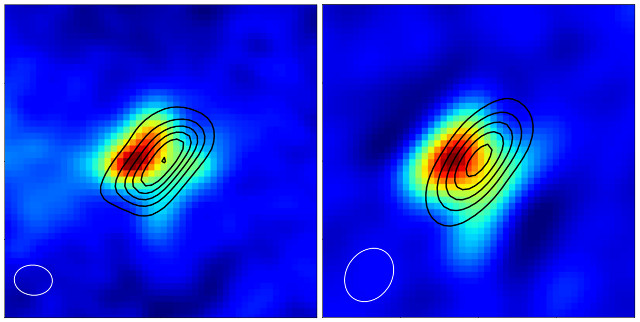
The top image (2019 The Astrophysical Journal / Shogo Tachibana et al.) illustrates the map of aluminum monoxide emissions at 497 GHz on the left and at 650 GHz on the right around the star Orion Source I. It indicates that it’s limited to one specific region, the one of the ouflow from the protoplanetary disk. This suggests that that molecule was initially in its gaseous form and then condensed into solid grains similar to those discovered in the form of inclusions in various meteorites such as Allende.
It’s the first time that the distribution of aluminum monoxide has been discovered around a young star and this makes the Orion Source I system even more interesting. Shogo Tachibana explained that these results allow us to place closer constraints on the hypotheses that describe our stellar evolution but there’s still a lot of work to be done. In fact, he and his team intend to explore gas and solid molecules around other stars to collect useful data to further refine the solar system models. Instruments such as ALMA are excellent to discover these molecules and helping us to reconstruct the processes that led to the formation of the solar system through the study of other systems still in formation.

