
An article published in the “Journal of Geophysical Research: Planets” reports the results of computer simulations generated to explain the asymmetry of the two faces of the Moon. A team of researchers used data from NASA’s GRAIL mission as a reference to try to reproduce the Moon’s situation, concluding that the best explanation comes from the simulation of the impact of a dwarf planet with a diameter of about 780 kilometers on the current Earth-facing Moon’s side at about 22,500 km/h.
The origin of the Moon is probably due to an impact of a Mars-sized with the primordial Earth. However, the Moon shows some anomalies that have been studied for decades to understand their origin and don’t agree with its origin following an impact. Its two faces are very different with the hidden one full of craters while the Earth-facing one has large basins. The analyzes of lunar minerals also show some differences in the abundance of potassium, phosphorus and rare earth isotopes such as tungsten-182 which at least apparently contradict the theory of the common origin of Earth and Moon.
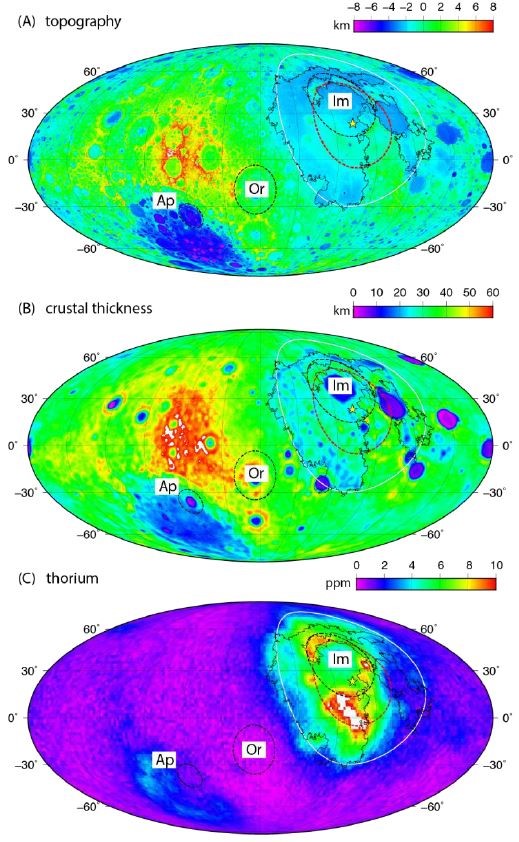
The image (Courtesy JGR: Planets/Zhu et al. 2019/AGU. All rights reserved) shows the topography (A), the crust thickness (B) and the distribution of thorium (C) on the Moon with the notable differences between the two faces. The black dotted lines represent the boundaries of the Imbrium (Im), Orientale (Or) and Apollo (Ap) basins.
Various hypotheses have been made over time: perhaps originally there were two moons that merged very soon after their formation but in the past someone suggested that the Moon could have been hit by a very massive asteroid after the its crust had already formed devastating that of one of the two faces.
The studies of the Moon continued over the decades in various ways, including NASA’s GRAIL mission, completed in December 2012 with the impact of the twin spacecraft Ebb and Flow, which had the purpose of collecting information on the Moon’s composition, including its crust thickness and its differences in the two faces, also to help the researchers to explain its origin and its evolution.
Dr. Meng Hua Zhu of the Space Science Institute at Macau University of Science and Technology, lead author of the article, recognized the importance of the detailed data obtained from the GRAIL mission. Thanks to those data the researchers were able to more accurately evaluate the results of 360 computer simulations generated to test possible scenarios that include an impact on the primordial Moon.
In the simulation that best matches the available data, there was the impact of a dwarf planet with a diameter of about 780 kilometers, slightly smaller than the dwarf planet Ceres, current Earth-facing Moon’s side at about 22,500 km/h. In the second best candidate the dwarf planet is a little smaller with its 720 kilometers in diameter and the impact occurred at a slightly higher speed, around 24.500 km/h.
In both possible scenarios, the impact threw up enormous amounts of materials that fell back to the Moon’s surface burying the primordial crust on whats today the hidden face in a layer of debris between 5 and 10 kilometers thick detected by the GRAIL spacecraft. In both cases, it wasn’t a second moon but a dwarf planet orbiting the Sun before its orbit crossed that of Earth and Moon.
This hypothesis also provides an explanation for the differences in the abundance of potassium, phosphorus and rare earth isotopes such as tungsten-182 between the the Earth and that the Moon’s surface. If they had a common origin the various elements should have very similar percentages of isotopes and the anomalies would be explained by the materials brought by a foreign body such as a dwarf planet that hit the Moon.
This research is based on computer simulations so it’s a theory with results matching some of the Moon’s features. More research will be needed but it’s interesting also to try to explain that kind of differences in other bodies of the solar system.

Permalink