
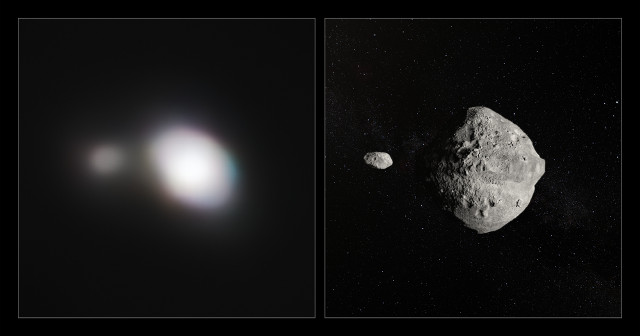
ESO has published photos of the asteroid 1999 KW4 taken using the SPHERE instrument mounted on the VLT in Chile. This is part of a campaign of observations coordinated by the International Asteroid Warning Network (IAWN), which followed the UN recommendations to set up the control of potentially dangerous asteroids. 1999 KW4 passed 5.2 million kilometers from the Earth on May 25, 2019, an absolutely safe distance but it was a good opportunity to assess the possibility of keeping an eye on the trajectory of what’s actually a double asteroid even using an instrument designed to photograph exoplanets.
The asteroid 1999 KW4 – complete designation (66391) 1999 KW4 – was discovered on May 20, 1999 by the Lincoln Near-Earth Asteroid Research (LINEAR) project. It belongs to the Aten class, a group of NEOs (Near-Earth Objects) whose semi-major axis is less than the average distance between the Earth and the Sun. Its orbit crosses that of Venus and Mercury since it reaches a minimum distance from the Sun that is only 20% of the average of the Earth from the Sun. It has an average diameter of about 1.3 kilometers and its year lasts about 188 Earth days.
A peculiarity of the asteroid 1999 KW4 was noted in 2000 and made astronomers suspect that it had a moon. This was confirmed in 2001 thanks to subsequent radar observations made at the Arecibo radio telescope. Listed as S/2001 (66391) 1, this moon has an average diameter of about 360 meters and orbits 1999 KW4 at a distance of about 2.6 kilometers with an orbital period of about 16 hours.
At least for the near future, the asteroid 1999 KW4 will not be a danger to the Earth but its close passage represented an opportunity to study and verify the coordination of the various entities that work together in checking on asteroids. Knowing these objects’ characteristics can provide new information to understand their dangers and in the future also to understand if they contain useful elements and compounds for space mining operations. ESO has joined the campaign of observations with its Very Large Telescope (VLT), which among its instruments has SPHERE, activated in June 2014 to photograph exoplanets.
The observations of the asteroid 1999 KW4 have been difficult, which may seem strange since it’s an instrument used to photograph planets light years away. The problem was the 1999 KW4’s speed, over 70,000 km/h. The unstable weather conditions also contributed to the difficulty of the deed but in the end Diego Parraguez, who piloted the VLT, managed to lock on the target.
The images corrected thanks to the SPHERE instrument’s adaptive optics showed the asteroid 1999 KW4 and its moon as two distinct objects. It’s one of the very few instruments capable of obtaining images that are sharp enough to distinguish them. They still appear as two bright blobs in the dark background in ESO’s image that portrays them next to their artistic representation but that’s a progress in the study of a NEO-type asteroid, also for the positive result of the use of an instrument designed for quite different observations.
Astronomers noticed a similarity with another double asteroid, Didymos and its moon Didymoon. They were selected for a dual mission, as one phase will be accomplished by NASA with the impact of the DART space probe on Didymoon to try to alter its orbit and one by ESA with the Hera space probe that will survey the two asteroids.
For a few days the asteroid 1999 KW4 will still be visible also with amateur telescopes. In the future other asteroids will pass much closer to the Earth and that will be discussed on June 30, the date chosen for the so-called Asteroid Day, a global event supported by the UN to raise awareness about the potential dangers of asteroids. ESO is one of the entities engaged in improving the surveillance of the skies, waiting to have effective defenses.
