An article published in the journal “Nature” reports the detection of an interstellar gas disk around Sagittarius A*, the supermassive black hole at the center of the Milky Way. A team of researchers led by Elena Murchikova of the American University of Princeton found thanks to the ALMA radio telescope the radio emissions of the least hot component of the accretion disk that surrounds Sagittarius A*. By mapping those emissions it was possible to notice that disk’s rotation, another useful piece of data to study the processes taking place around that black hole.
So far, astronomers managed to capture in particular images of the hottest component of the accretion disk surrounding the supermassive black hole Sagittarius A*, where the gas reaches temperatures around 10 million degrees Kelvin. At those temperatures, the gas emits X-rays that can be detected by space telescopes designed for those frequencies. Radio observations allowed to detect much less hot gas emissions, around 10,000 degrees Kelvin, within a few light years from the black hole also thanks to its continuous ionization which produces a strong signal at millimeter wavelengths.
Now the team led by Elena Murchikova of the Institute for Advanced Study at the University of Princeton has gone further by using the ALMA (Atacama Large Millimeter / submillimeter Array) radio telescope, inaugurated in March 2013, to obtain the first measurements of the “cool” gas at much shorter distances from the Sagittarius A* supermassive black hole, reaching up to about one hundredth of a light year, about one thousand times the distance of the Earth from the Sun. ALMA’s power and sensitivity allowed to map the location of the gas tracing its movement and estimating its mass at about a tenth of the planet Jupiter’s, a result possible at the moment only with this instrument.
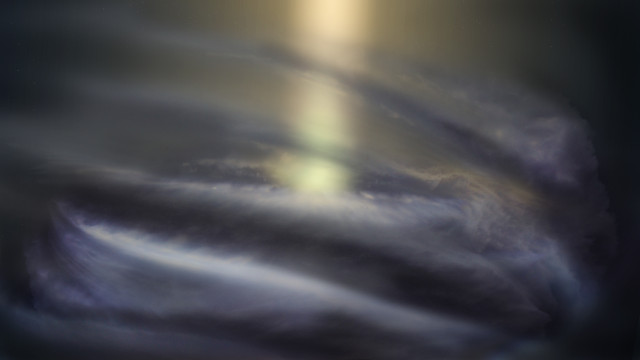
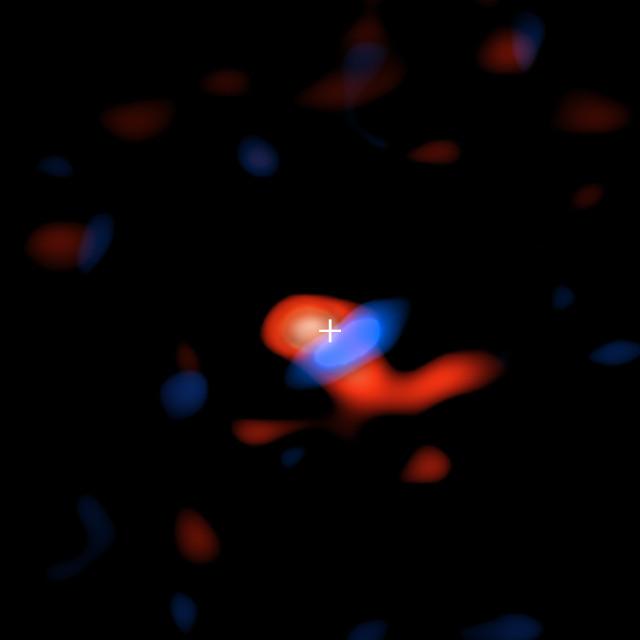
The top image (Courtesy ALMA (ESO/NAOJ/NRAO), E. Murchikova; NRAO/AUI/NSF, S. Dagnello. All rights reserved) shows the image of the “cool” hydrogen captured by the ALMA radio telescope. The colors show the movement of the gas in relation to the Earth: in red the gas that’s moving away, in blue the gas that’s moving towards the Earth. The bottom image (Courtesy NRAO/AUI/NSF; S. Dagnello. All rights reserved) shows an artistic representation of that gas disk.
The processes underway in the area surrounding the supermassive black holes have been studied since instruments that can carry out adequate detections have existed but even if today there are instruments such as ALMA there’s still much to be clarified. In the case of the accretion disk, it’s a question of understanding exactly how gas and dust are transported around Sagittarius A* and this will help to understand its influence beyond that disk, which can also affect star formation.
The Sagittarius A* supermassive black hole is relatively quiet compared to active galactic nuclei, which are visible at billions of light years away, but the area around it is still chaotic. Emissions from that area come in very different wavelengths and this makes it difficult to study them.
Precisely because it’s the first time that the “cool” hydrogen component around Sagittarius A* has been mapped there were also some skeptical comments regarding this result because no other observation had come close to it. The problem in this case is that at the moment ALMA seems to be the only instrument capable of obtaining such complete observations so it’s good that this research continues given that Elena Murchikova stated that her team is also examining the accretion onto the supermassive black hole to better understand that process. Gradually, research is clarifying what’s happening at the center of the Milky Way.