
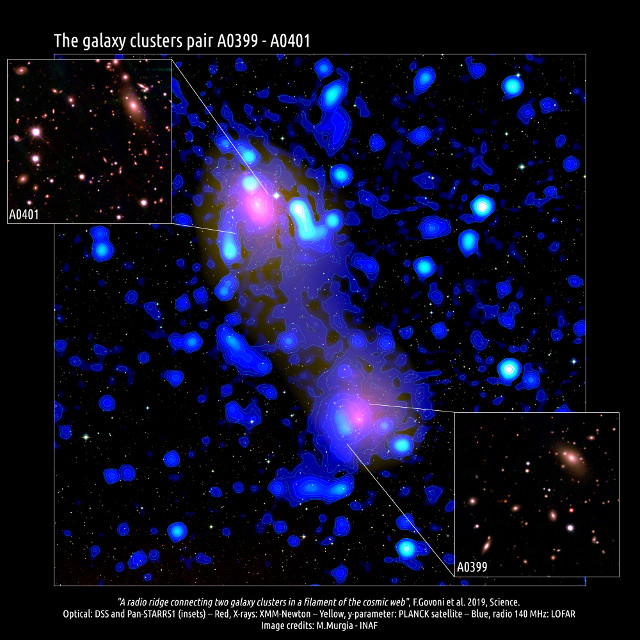
An article published in the journal “Science” reports the identification of electromagnetic fields along a filament that crosses the approximately 10 million light years between the Abell 0399 and Abell 0401 galaxy clusters. A team of researchers led by Federica Govoni of the National Institute of Astrophysics, Cagliari, used the Low Frequency Array (LOFAR) radio telescope to carry out for the first time measurement of such a structure in radio waves.
The so-called cosmic web formed by the distribution of matter in the universe includes galaxies grouped by gravitational bonds into more or less large clusters connected by filaments that could be composed at least in part of dark matter. Their study isn’t easy because they’re rarefied and if they really contain dark matter it will be even more difficult to examine them because so far astronomers have been able to observe only the gravitational effects generated by dark matter. A new possibility emerged in the examination of the pair of galaxy clusters Abell 0399 and Abell 0401, connected by a filament in which a magnetic field was discovered for the first time thanks to the emission of radio waves.
Some galaxy clusters can have in the central zones a sort of radio emission halo confirming the presence of a magnetic field and the Abell 0399 and Abell 0401 clusters, at little more than 900 million light years from the Earth, are two cases of this type already known for a long time. The surprise came more recently by examining the surveys carried out by ESA’s Planck Surveyor space probe, which showed the presence of a filament connecting the two clusters and this stimulated the curiosity of Federica Govoni and her team, who started investigating the possible extension of the magnetic field beyond the center of the two clusters up to the filament that connects them.
The image (DSS and Pan-STARRS1 (optical), XMM-Newton (X-rays), PLANCK satellite (yparameter), F. Govoni, M. Murgia, INAF) shows the Abell 0399 and Abell 0401 clusters, also in the insets. In their central parts there’s very hot plasma that emits X-rays shown in red. A tenuous yellow filament connects the two clusters. The radio emissions in blue show sources associated to galaxies and two haloes spread at the center of the two clusters but also between them.
The use of the LOFAR radio telescope allowed to detect what Federica Govoni compared to an aurora on cosmic scales. The detected radio waves are emitted as synchrotron radiation due to the very energetic electrons that move within the magnetic fields. That mechanism is observed in single galaxies and also in galaxy clusters but it’s the first time that it’s observed in a filament that connects two clusters.
The problem is that even electrons at relativistic speeds shouldn’t have enough energy to cover the distance between the two galaxy clusters. One possibility is that the shock waves produced during the structure’s formation provided the energy they need, however it’s a hypothesis that must be investigated.
The researchers intend to look for other similar structures to understand whether the one between the Abell 0399 and Abell 0401 clusters is a unique case or just the first discovered of a common type but they’ll probably need to wait for SKA, the next generation radio telescope, of which LOFAR is a precursor. SKA will be able to obtain better detections of filaments that connect galaxy clusters and perhaps other magnetic fields to understand their origin and characteristics.
