
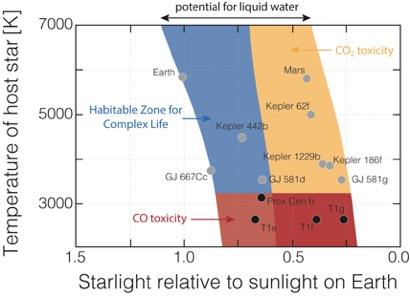
The presence of toxic gases could limit the habitability of rocky exoplanets
An article published in the journal “The Astrophysical Journal” offers a new definition of the habitable zone of a star system where a planet that can accommodate life forms similar to the Earth’s can orbit. A team of researchers coordinated by the University of California – Riverside examined the available data on the atmospheres of exoplanets with orbits in what until now has been considered the habitable zone discovering that in most cases there’s an amount of carbon dioxide and carbon monoxide toxic for complex life forms as we know them. In essence, the new definition significantly reduces the habitable zone.
