July 2019

LTT 1445 aka LTT 1445ABC (Image NASA / ESA / Hubble)

An article to be published in “The Astronomical Journal” reports the discovery of a super-Earth that was cataloged as LTT 1445Ab thanks to NASA’s TESS space telescope in a research coordinated by the Harvard-Smithsonian Center for Astrophysics. This exoplanet orbits a red dwarf and from the estimates seem too close to it to have the potential to host life forms similar to the Earth’s but it’s interesting because that star has two companions, red dwarfs as well, and orbits them.

The Chandrayaan 2 with the launch of a GSLV Mk-III rocket (Image courtesy ISRO)

A little while ago a GSLV Mk-III rocket blasted off from the Indian Satish Dhawan Space Centre with the Chandrayaan 2 mission’s orbiter, the Vikram lander and the Pragyaan rover. After just over 16 minutes, the vehicles separated from the rocket’s last stage to begin the series of maneuvers that will slowly stretch their orbit to bring them into the area of ​​influence of the Moon, where the lander and rover’s landing is scheduled as soon as September 6.

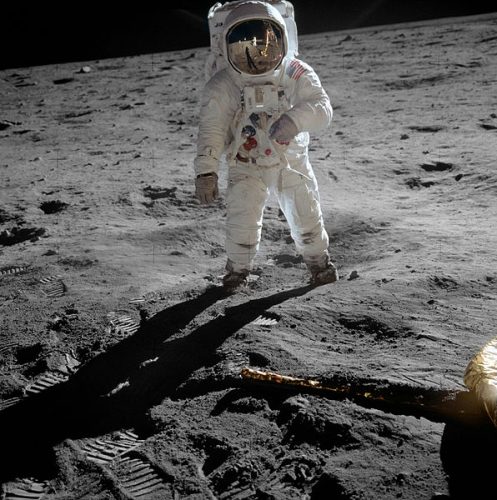
Buzz Aldrin photographed by Neil Armstrong, visible in the helmet's reflection (Photo NASA)

On July 20, 1969, NASA’s Apollo 11 mission’s lunar module Eagle, started on July 16, accomplished the first Moon landing of a manned spacecraft. Mission commander Neil Armstrong and lunar module pilot Edwin “Buzz” Aldrin participated in the landing and spent just over two hours on the surface of the Moon to collect some samples that were brought back to Earth. Once they departed the Moon, the two astronauts rejoined Michael Collins, who remained in orbit in the command module Columbia and returned to Earth on July 24th.

Using red giants to estimate the speed of the universe expansion

An article being published in “The Astrophysical Journal” reports a new attempt to calculate the speed of the universe expansion, this time using red giant stars as a reference. A team of researchers coordinated by Carnegie Institution for Science and University of Chicago and led by astronomer Wendy Freedman used observations made with the Hubble space telescope to perform that calculation. The result has a probability peak at 69.8 km/s per megaparsec, between the values ​​calculated using the two methods that provided discrepant values.