An article published in “The Astrophysical Journal” reports a study on the supernova SN 2016iet. A team of researchers used a number of telescopes to collect data on it. Almost three years of study have followed its first sighting, which happened on November 14, 2016, leading to estimate that the progenitor star had a mass about 200 times the Sun’s which exploded in what appears to be the first strong case of pair-instability supernova, which ends with the star’s total destruction.
The supernova SN 2016iet was discovered by ESA’s Gaia space probe during its sky mapping work in a previously uncataloged dwarf galaxy about a billion light years from Earth. Sebastian Gomez, lead author of the study on this supernova, explained that immediately after its first sighting, which took place on November 14, 2016, astronomers noticed some oddities and that his first thought was that there was something very wrong with the data.
The many follow-up observations carried out after the discovery of the supernova SN 2016iet confirmed its unique characteristics such as its very long duration, considerable energy, unusual chemical “signatures” and a poor metal environment. Edo Berger, another of the authors of this study, confirmed that everything about this supernova seems different: its change of brightness over time, its spectrum, its galaxy of origin and its position within that galaxy. He added that sometimes astronomers see supernovae that are unusual in one aspect but otherwise are normal but this one is unique in every possible way.
The analysis of the collected data allowed to reconstruct the history of the supernova SN 2016iet and its progenitor star. That star had to be supermassive with a mass about 200 times the Sun’s and its formation occurred in isolation at about 54,000 light years from the center of the dwarf galaxy that hosted it. Such a huge star consumes its hydrogen at extremely high speeds and has a very short life for stars standards of a few million years. However, with its violent activity it had already lost about 85% of its mass during its short and intense life.
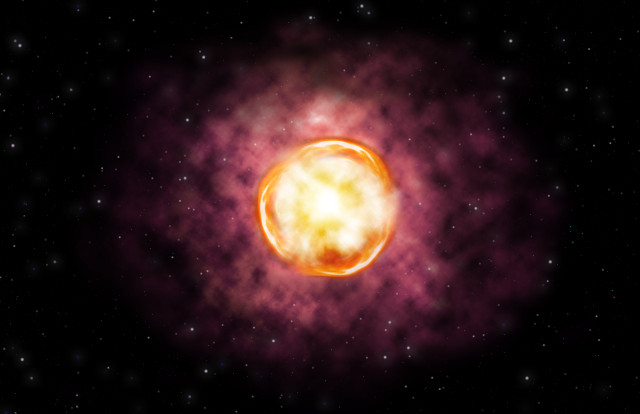
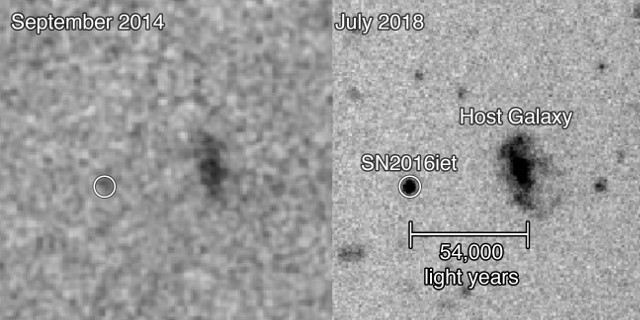
The top image (Courtesy Center for Astrophysics | Harvard & Smithsonian. All rights reserved) shows a comparison between the observations of the area of supernova SN 2016iet in September 2014 and in July 2018 conducted with the Magellano Clay telescope. The bottom image (Courtesy Gemini Observatory/NSF/AURA / illustration by Joy Pollard. All rights reserved) shows an artistic representation of SN 2016iet with the explosion of the star surrounded by materials ejected in previous years.
The supernova caused a collision of the materials ejected in the explosion with the ones that got ejected in the previous years generating an unusual appearance. According to the researchers there are strong indications that it was a pair-instability supernova. Previously some candidates were found for that type of supernova, which can only occur in very massive and metal-poor stars but in the case of SN 2016iet there seems to be more evidence.
One of the peculiarities of pair-instability supernovae is to cause the total destruction of the progenitor star. Normally, even when a star dies in a supernova, it still leaves an intact core that, depending on its mass, collapses into a neutron star or a black hole. When these supergiant stars explode the core collapse produces an enormous amount of gamma rays which leads to a runaway production of particles and antiparticles pairs which eventually triggers a thermonuclear explosion that destroys the core too.
According to the models, the first stars of the universe were supermassive and metal-poor so they probably died in pair-instability supernovae. The problem was to find a case with characteristics similar to the first stars visible today and SN 2016iet could be it. It’s an anomalous star also because generally supermassive stars are born in huge clusters formed by thousands of stars, not in isolated areas.
Generally the extraordinary brightness of supenove fades away to the point of becoming invisible in their host galaxy’s glow within a few months. SN 2016iet is so bright and isolated that it will be possible to keep on studying its evolution for years. This study is just the beginning and the researchers are continuing to monitor the ongoing processes.
The supernova SN 2016iet already offered new clues on various cosmic phenomena and its extraordinary duration could allow to confirm that it was a pair-instability supernova and to better understand the life and death of the first stars of the universe, which influenced the whole subsequent story.