
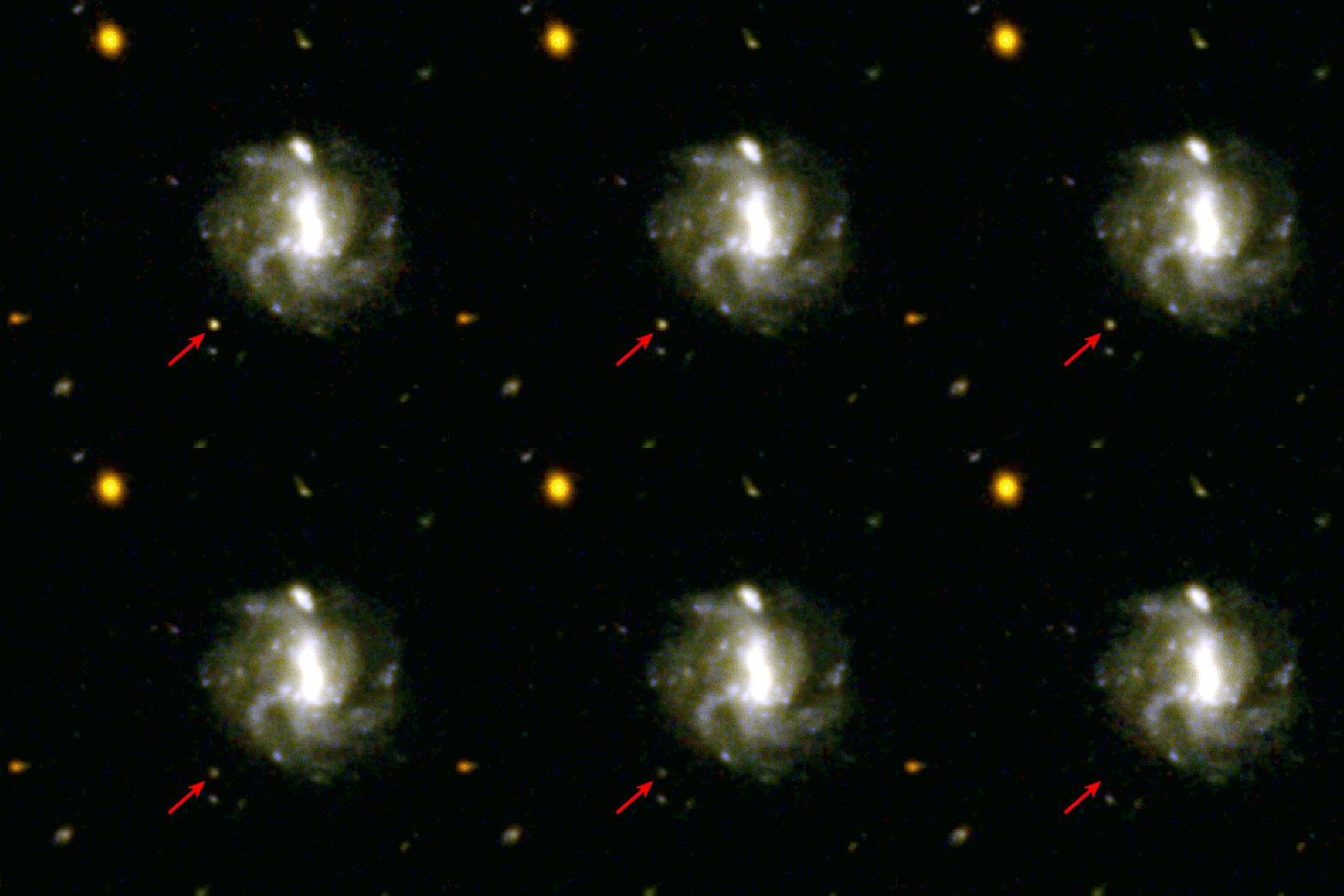
An article published in the journal “Monthly Notices of the Royal Astronomical Society” reports a study on the short-duration gamma-ray burst cataloged as GRB160821B that has characteristics that match those of the merger of neutron stars observed at both electromagnetic waves and gravitational waves on August 17, 2017. A team of researchers led by Eleonora Troja of the University of Maryland used data collected from various telescopes to compare the two events and the 2016 one was observed since its early hours providing new information on the initial phase of what’s called a kilonova.
The event cataloged as GW170817 detected at gravitational waves from the LIGO experiment and subsequently at electromagnetic waves by many telescopes marked the history of multimessenger astronomy and continues to be a reference point for astronomers in various ways. Together with the VIRGO detector, the LIGO collaboration keeps on looking for other such events but there are also researchers who went to review the data collected after the detection of short-duration gamma-ray bursts similar to the one associated to the kilonova.
An article published in the journal “Nature Communications” in October 2018 reported an analysis of the gamma-ray burst cataloged as GRB150101B by the team led by Eleonora Troja, a researcher at the University of Maryland and NASA. Now some members of that team together with other colleagues reviewed the data for another gamma-ray burst, the one catag
as GRB160821B. The animated image (NASA/ESA/E. Troja) shows this event over 10 days.
In the case of the gamma-ray burst GRB160821B, NASA’s Swift space observatory was the first to detect that event, being a mission that aims exactly to study gamma-ray bursts. Subsequently, other space and ground-based telescopes detected electromagnetic emissions at very different wavelengths. The variety isn’t at the level of the kilonova observations and gravitational wave detections are missing but an event that at a certain point seemed a disappointment because after ten days almost no signal was left could be very interesting after all.
Studying these cosmic events better can help understand what happens in the medium to long term after a kilonova. What remains may still be a neutron star but if there’s enough mass it can collapse into a black hole. Various elements are produced following the merger and among them there’s gold. That’s accompanied by strong infrared emissions that are the most studied ones by Eleonora Troja’s team.
Eleonora Troja and her team keep on looking for possible kilonovas in events observed in recent years, when electromagnetic emissions were detected but not gravitational waves. To improve this research it would be good to have other complete observations of kilonovas and it should be only a matter of time. The LIGO and VIRGO detectors work together and often discover potential extreme events, which are usually black hole mergers but the event of August 14 cataloged as S190814bv could have been a merger between a black hole and a neutron star with a kilonova. This is a new frontier in astronomy so every day a new discovery could bring progress.
