
An article published in “The Astrophysical Journal” reports a research on variations in the gravitational field of the planet Saturn due to internal vibrations. Yanqin Wu of the University of Toronto and Yoram Lithwick of Northwestern University used data collected by the Cassini space probe during its ring flybys to study the phenomenon, concluding that Saturn’s vibrations were caused by past impacts that made the planet sort of ring like a bell.
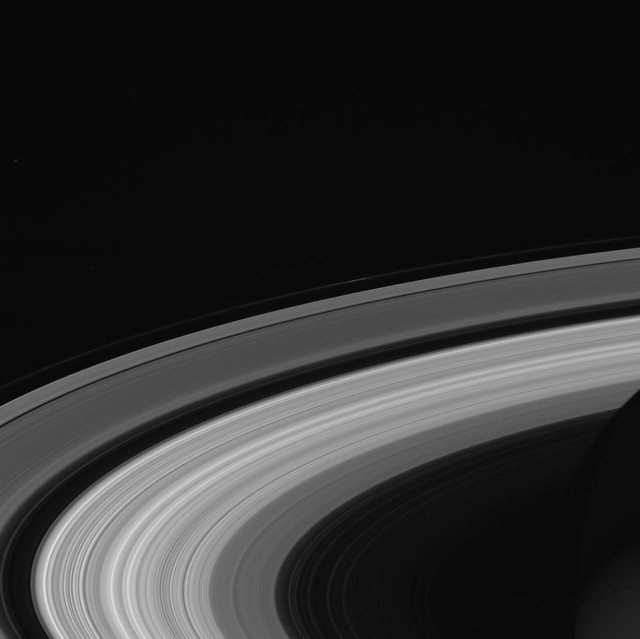
The Cassini mission ended on September 15, 2017 with the destruction of the space probe in the planet Saturn’s atmosphere, leaving behind a wealth of data collected over the years. In particular, during the last phase called the Grand Finale, maneuvers were carried out that had previously been considered risky such as ring flybys and between the planet and the rings. They offered more valuable information on those extraordinary formations that can sometimes be useful even to discover something new about Saturn itself. The image (NASA/JPL-Caltech/Space Science Institute) shows one of the last photographs of Saturn’s rings taken by Cassini, precisely on September 13th 2017.
This new research exploits the seismology of the planet Saturn using the effects that the vibrations inside it have on the planetary gravitational field and consequently on the particles that make up the rings, which were used as if they were natural seismometers. Probably not all the vibrations have that origin but the collisions that occurred during the planet’s history may have made its heart ring in the way detected today.
There’s also the possibility that vibrations of that type are generated by sandstorms that could be generated at considerable depths within Saturn, at pressures that can be 10,000 times higher than on the Earth’s surface. Those storms are still theoretical but no evidence of their actual existence has yet been found so it’s not possible to determine whether they can generate vibrations.
The complex calculations made based on the data collected by the Cassini space probe must take into account the presence of the moons that orbit outside the rings. It’s a recent phase of research on Saturn that according to the authors could be applied to the reconstruction of the history of other planets. In this research the authors mentioned the situation of the planet Jupiter, which has thin rings composed mainly of dust. The surveys carried out by NASA’s Juno space probe could be useful to try to use seismology on Jupiter as well.
