
An article published in the journal “Nature Communications” reports the discovery of a new method to form the organic compounds of the polycyclic aromatic hydrocarbon (PAH) group in space. A team of researchers at the Berkeley National Laboratory found what in jargon is called a pathway to get to the formation of PAHs such as naphthalene from simpler molecules. These compounds are important in the formation of amino acids, the building blocks of large biological molecules.
Organic molecules have been found in growing abundance in space thanks to increasingly sophisticated instruments and among them PAHs turned out to be common to the point that it’s estimated that up to 20% of the galactic carbon is part of compounds of that type. Their formation processes on Earth are well known and have also been studied because they’re toxic compounds, in some cases carcinogenic, but their formation processes in space have been more difficult to understand. The problem is that they get formed in environments that are difficult to study such as circumstellar envelopes of carbon stars. Scientists at the Berkeley National Laboratory succeeded in doing that by starting with free radicals.
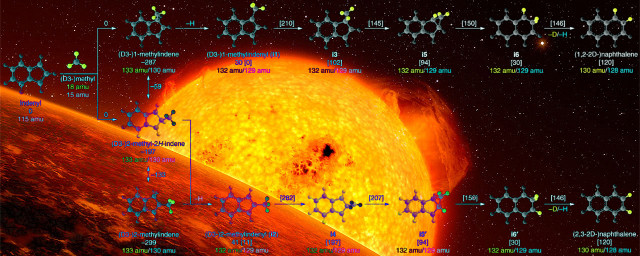
The composite image (ESO/L. Calçada; Berkeley Lab, Florida International University, and University of Hawaii at Manoa) shows a carbon star that heats an exoplanet and the chemical pathway discovered in this research superimposed.
In the experimental verification, they used a chemical micro-reactor heated at temperatures reproducing those existing in circumstellar envelopes of carbon stars. A vacuum ultraviolet (VUV) beam was used to strike free radicals and a reflectron time-of-flight mass spectrometer was used to detect the compounds that formed and were ejected from the micro-reactor. The reaction between aliphatic methyl radical and aromatic 1-indenyl radical at about 1,000° Celsius (about 2,105° Fahrenheit) generated by that light beam produced naphthalene.
The experimental part of this research was accompanied by a computer analysis of chemical reactions. It’s in addition to previous studies in which the researchers had already identified a couple of other pathways for PAH formation in space. This means that it’s possible for these organic compounds to form along different pathways, a factor that Musahid Ahmed, one of the authors of the research, pointed out as interesting because it’s possible that all those pathways actually lead to PAH production in space.
This type of research aims to understand how life on Earth could have been born also thanks to the formation of PAHs in space that spread until they reached the Earth. However, the researchers also pointed out that the methods they used can bring progress also in broader studies concerning chemical reactions that include radicals at high temperatures such as materials chemistry and materials synthesis. In essence, studies based on astronomy and astrobiology can be helpful in other disciplines as well with practical applications.

Permalink