
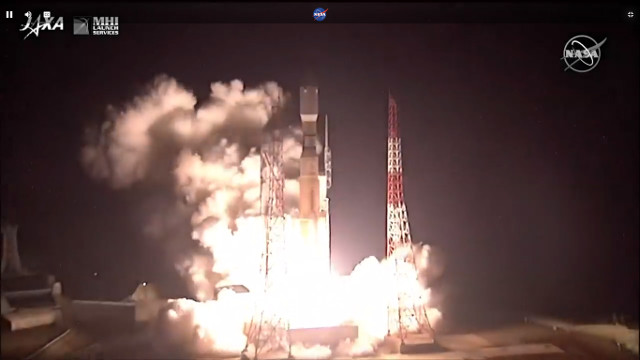
A little while ago the HTV-8 spacecraft blasted off atop a H-IIB rocket from the Tanegashima space center in Japan for a resupply mission to the International Space Station. About fifteen minutes after the launch, the cargo spacecraft separated regularly from the rocket’s last stage, entered its preliminary orbit and deployed its solar panels and navigation antennas.
The HTV-8 (H-II Transfer Vehicle) spacecraft is also called Kounotori, which means white stork. It carries a total of about 5,300 kg (11,700 lb) of cargo to the International Space Station between the pressurized and non-pressurized section. There are supplies such as water and food for the crew as well as new instruments, scientific experiments, various hardware and some CubeSat-class nanosatellites to be put into orbit from the Station.
Like in last year‘s HTV-7 mission, new lithium-ion batteries and related accessories that will replace old batteries are aboard, this time 8 of them. They’ll be used to accumulate the energy obtained from one of the solar panel blocks of the International Space Station. For this reason, they’re not only a considerable part of the cargo but also a very important part for the Station’s maintenance.
This resupply mission began two weeks late because the previous launch attempt was aborted following a fire that started on the launch pad a few hours before lift-off. The fire was promptly extinguished but the countdown was interrupted. The investigation indicated that most likely the fire was caused by static electricity that generated flames in an environment that in the hours preceding a launch becomes particularly rich in oxygen.
The HTV-8 spacecraft went into a route that takes almost four days to reach its destination so it’s scheduled to arrive at the International Space Station next Saturday, around 11.15 UTC. It will be captured by the Canadarm2 robotic arm, like the American cargo spacecraft Dragon and Cygnus.

Permalink