
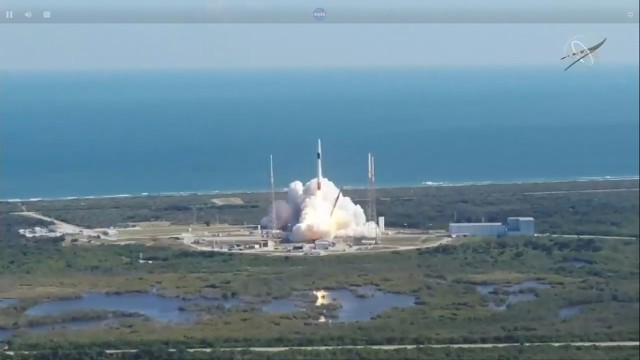
A little while ago the SpaceX Dragon spacecraft blasted off atop a Falcon 9 rocket from Cape Canaveral in its CRS-19 (Cargo Resupply Service 19) mission, also referred to as SPX-19. After just over ten minutes it separated successfully from the rocket’s last stage and went en route. This is the 19th mission for the Dragon spacecraft to resupply the International Space Station with various cargoes and then return to Earth, again with various cargoes.
The Dragon spacecraft’s cargo is a little more than 2,600 kg (almost 5,800 lbs) between the pressurized and the non pressurized section. There are about 260 kg (a little more than 560 lbs) of food and other supplies for the International Space Station crew but most of the cargo consists of instruments, hardware and various other materials needed to science experiments and research conducted aboard the Station.
Among the experiments connected to the production of food in space there’s the Malting ABI Voyager Barley Seeds in Microgravity, which aims to test malting from barley in microgravity and verify the differences from the normal malting on Earth.
Safety is crucial in a space station, but years ago on the Mir they risked a catastrophe due to a fire. Experiments like Confined
Combustion allows studying the spread of fire in microgravity. That’s useful to understand how to control a possible fire.
Often groups of mice are sent to the International Space Station to conduct biological experiments. The Rodent Research-19 (RR-19) investigation includes a group to evaluate the influence of myostatin, a protein that limits muscle development in animals. Some mice were created by genetic engineering so as not to produce it, others will be given an experimental drug that blocks the activity of myostatin.
The Dragon spacecraft is the same that was already used in the CRS-6 mission, started on April 14, 2015, and CRS-11, started on June 3, 2017. This is the second cargo spacecraft used for the third time, a sign that reusing a Dragon is becoming a routine.
Generally after the launch of a Dragon cargo spacecraft, the Falcon 9 rocket’s first stage lands on a Cape Canaveral pad, but in this launch a longer thrust was needed. SpaceX is conducting experiments on its rocket’s second stage to verify the possibility of performing prolonged missions that require the second stage to carry out various maneuvers over the course of a number of hours to inject satellites into high-energy orbits. For this reason, today the second stage has landed on the marine drone ship “Of Course I Still Love You”.
Now the Dragon cargo spacecraft is en route to the International Space Station and everything proceeds normally. The arrival is scheduled for Sunday: at about 11 UTC, the Dragon is scheduled to be captured by the Station’s robotic arm.

Permalink