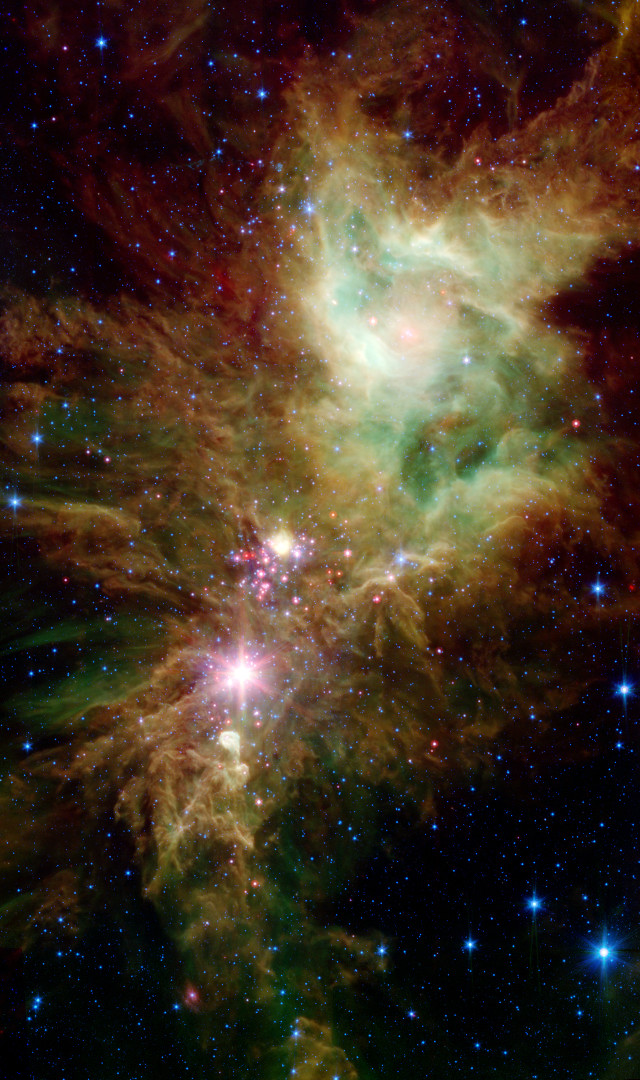
Image Credit: NASA/JPL-Caltech/P.S. Teixeira (Center for Astrophysics))
NASA’s Spitzer space telescope captured a new image of the so-called Christmas Tree Cluster, so nicknamed for its shape. That appearance is enhanced by a remarkable star formation with the consequent presence of protostars that emit a light that appears pink or red to Spitzer that gives the area an effect similar to the Christmas tree’s balls. It’s part of a set of objects collectively known as NGC 2264 which also includes the Snowflake Cluster, the Cone Nebula and the Fox Fur Nebula.
About 2,600 light-years away from Earth, NGC 2264 is particularly interesting because it’s a star-forming area in which circumstances recently produced a concentration of gas that resulted in the birth of several stars. In astronomical terms, recently means that those stars have an estimated age of about 100,000 years and this makes them protostars because they have not yet reached their full stability. For this reason those stars are still close to each other while in a few million years they will have already moved away.
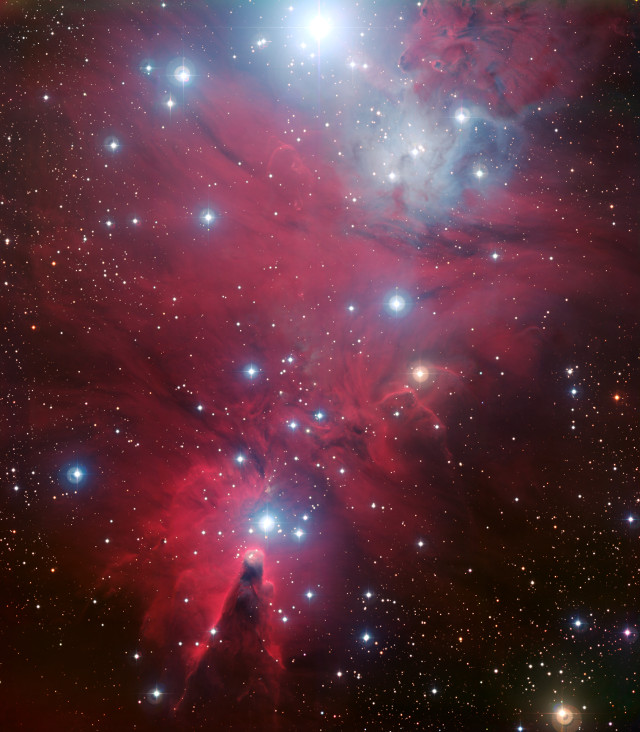
The Spitzer space telescope isn’t even the most suitable to capture the light of NGC 2264’s protostars because it’s sensitive to infrareds, the feature that makes it suitable to capture other colors of areas full of gas and dust that could keep on forming new stars for a long time. In the bottom image, captured at optical frequencies by the Wide Field Imager (WFI) camera on the 2.2-metre Max-Planck Society/ESO telescope at the La Silla observatory in Chile, the protostars emerge much more with the their brightness and the structure of the so-called Cone Nebula is clearly visible at the bottom.
A group of stars at the center of the top image forms a cluster that has a symmetrical structure that reminds of the shape of a snow crystal and for this reason it’s nicknamed the Snowflake Cluster. It forms a part of a larger cluster, nicknamed the Christmas Tree. They’re ephemeral shapes from an astronomical point of view and within not many millennia they could already be visibly distorted because various forces such as gravity and the violent stellar winds emitted by the protostars alter them all the time.
The massive stars of NGC 2264 ionize hydrogen in molecular clouds where more stars are likely to be born. The existing show will continue, varying over time with its evolution, while providing interesting information to astronomers studying star formation processes.