December 2019

Boeing's CST-100 Starliner spacecraft landing (Image NASA TV)

A little while ago Boeing’s CST-100 Starliner spacecraft landed at the White Sands Missile Range in New Mexico, ending its Boe-OFT (Boeing Orbital Flight Test) mission. Unlike the previous American spacecraft, this one doesn’t splash down in the ocean but lands on the ground. The ground staff intervened in an exercise of the assistance activity that will take place in manned missions.

Boeing's CST-100 Starliner spacecraft blasting off atop an Atlas V rocket (Image NASA TV)

A little while ago, Boeing’s CST-100 Starliner spacecraft blasted off atop a ULA Atlas V rocket from the Cape Canaveral base in its Boe-OFT (Boeing Orbital Flight Test) mission. After about 15 minutes it successfully separated from the rocket’s last stage. After a little more than half an hour the first of a series of maneuvers for orbit insertion was schduled but a problem emerged that required that the possible options to be assessed to have the CST-100 Starliner go for a proper orbit insertion and on its way to carry out its mission. Boeing has control of the spacecraft, which is in a stable orbit, so it’s not in danger.

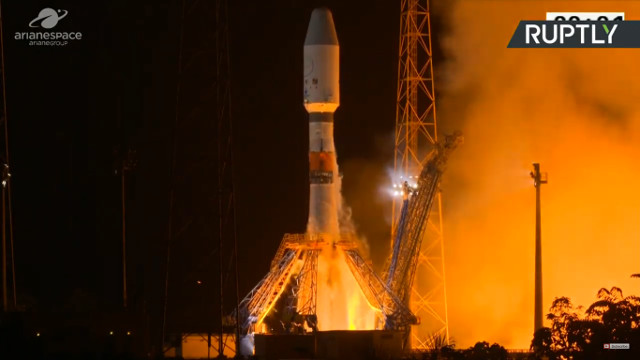
CHEOPS and Cosmo-SkyMed Second Generation blasting off atop aSoyuz rocket (Image courtesy Arianespace)

A few hours ago a Soyuz rocket was launched from the Kourou base, in French Guiana. After about 23 minutes the Cosmo-SkyMed Second Generation satellite successfully separated from the rocket’s Fregat last stage. About 85 minutes after the launch, the CHEOPS space telescope successfully separated from the rocket’s Fregat last stage.

The COSMO-SkyMed Second Generation satellite is the first of a constellation of two satellites that aims to replace the first generation’s four satellites. It’s a system of radar satellites for the territory observation, the result of a collaboration between the Italian Space Agency and the Italian Ministry of Defense.

The purpose of ESA’s CHEOPS (Characterizing ExOPlanets Satellite) space telescope is to conduct follow-up study of exoplanets using the transit method, which means observing the ones that pass in front of their star.

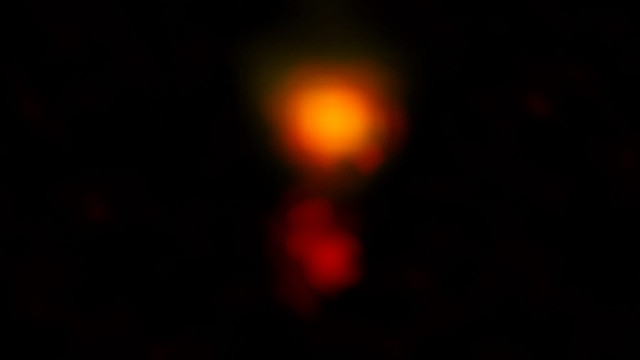
MAMBO-9 is a dusty galaxy 13 billion light years away

An article published in “The Astrophysical Journal” reports a study on a dusty early galaxy known as MAMBO-9. A team of researchers led by Caitlin Casey of the University of Texas at Austin used the ALMA radio telescope to study this galaxy about 13 billion light years away and its star formation rate much higher than the Milky Way’s. The observations showed that actually they’re two galaxies during a merger. That’s all useful to understand the role of dusty galaxies like that one in the evolution of the universe.

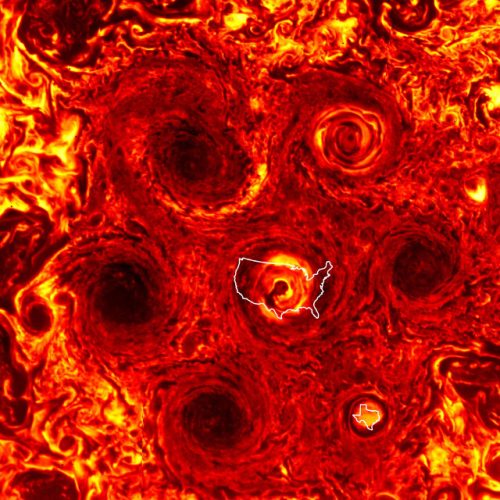
Jupiter's south pole seen by JIRAM

A new cyclone was discovered at the south pole of the planet Jupiter by NASA’s Juno space probe. In particular, it was the JIRAM instrument that captured the first images in which you can see that the configuration of the cyclones existing in that area changed from a pentagon of cyclones surrounding a central one to a hexagon, still around a central one. The new cyclone seems small compared to the ones already existing but its surface is comparable to that of Texas. This discovery was made during a Jupiter flyby that follows a maneuver needed to prevent Juno from ending up in the planet’s shadow for 12 hours. Without being powered by solar panels, its batteries would have completely drained and its temperature would have dropped to lethal levels.