2019

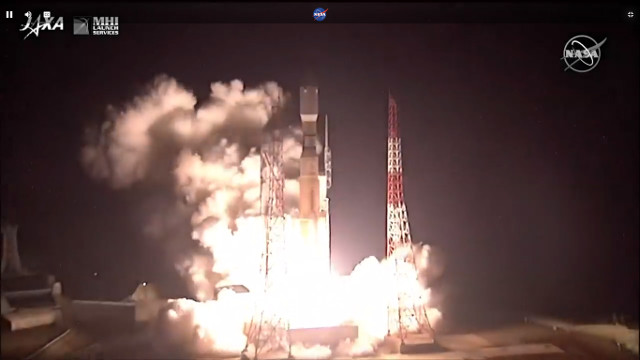
The HTV-8 cargo spacecraft blasting off atop a H-IIB rocket (Image JAXA / NASA TV)

A little while ago the HTV-8 spacecraft blasted off atop a H-IIB rocket from the Tanegashima space center in Japan for a resupply mission to the International Space Station. About fifteen minutes after the launch, the cargo spacecraft separated regularly from the rocket’s last stage, entered its preliminary orbit and deployed its solar panels and navigation antennas.

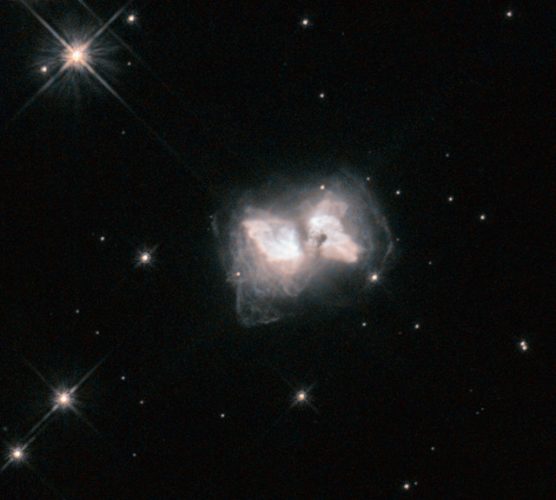
The AFGL 4104, or Roberts 22, protoplanetary nebula (Image NASA, ESA, and R. Sahai (Jet Propulsion Laboratory))

An article published in the journal “Monthly Notices of the Royal Astronomical Society” reports a study on the importance of the ejection of materials by stars in the last stages of their life in the formation of life forms such as those on the Earth. Professor Michael Smith and PhD student Igor Novikov of the British University of Kent performed a series of computer simulations of processes in protoplanetary nebulae obtaining results that offer important clues concerning the recycling of materials generated in stars and ejected into interstellar space.

Six galaxies were observed as they became quasars in a very short time

An article published in “The Astrophysical Journal” reports the discovery of six galaxies with active galactic nuclei (AGN) which showed a remarkable change in their brightness within a few months becoming quasars. A team of researchers used data collected during the first nine months of the Zwicky Transient Facility (ZTF) survey to discover those galaxies that were classified as LINERs, fairly common galaxies that are generally bright but far from quasars. It could be a new kind of activity of the supermassive black holes at the center of those LINER galaxies.

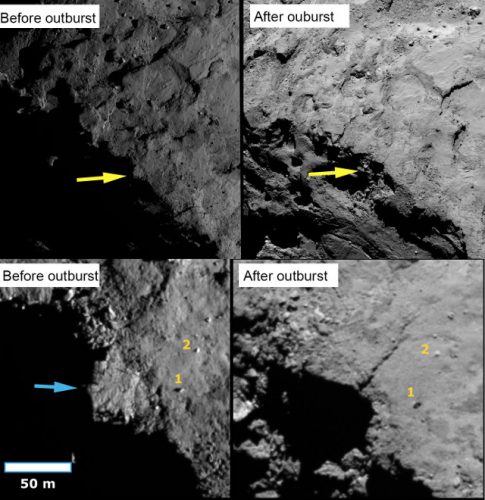
Collapsing cliffs and bouncing boulders on the surface of comet 67P/Churyumov-Gerasimenko

At the EPSC-DPS conference taking place in Geneva, Switzerland, new evidence was presented that on comet 67P/Churyumov-Gerasimenko there are collapsing cliffs and bouncing boulders. Some scientists examined the approximately 76,000 high-resolution photographs taken by the ESA’s Rosetta space probe’s OSIRIS camera to study the activity on the comet’s surface in the period in which it was active.