2019

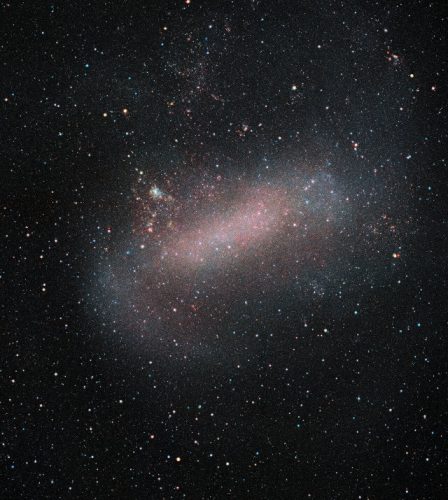
The VISTA telescope offers new details of the Magellanic Clouds

An article accepted for publication in the journal “Monthly Notices of the Royal Astronomical Society” reports the results of a study of the two Magellanic Clouds, satellite dwarf galaxies of the Milky Way. A team of researchers used data collected during the VISTA survey of the Magellanic Clouds system (VMC) exploiting the ability of ESO’s VISTA telescope to detect the near infrareds to show new details of the Magellanic Clouds.

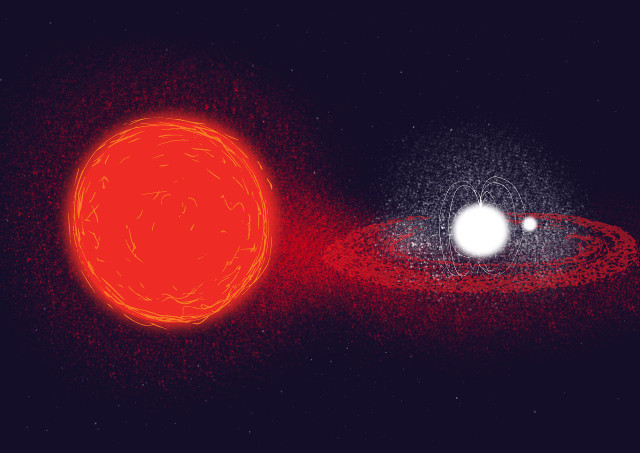
Artist's concept of the pulsar PSR J1023+0038 with its companion on its left (Image ESA)

An article published in “The Astrophyiscal Journal” reports a study of the pulsar PSR J1023+0038, which showed a peculiar behavior given that for the first time both visible light and X-ray emissions were detected. A team of researchers led by Alessandro Papitto of the Italian National Institute of Astrophysics used the Galileo National Telescope in the Canaries and ESA’s XMM-Newton Space Telescope to capture the different emissions of what’s classified as a millisecond pulsar for its very fast rotation speed and offer an explanation to his behavior.

C/2019 Q4 seen by the Canada-France-Hawaii Telescope (Image courtesy C/2019 Q4 seen by the Canada-France-Hawaii Telescope)

An object cataloged as C/2019 Q4 (Borisov) and identified as a comet discovered on August 30 by the amateur astronomer Gennady Borisov has a strongly hyperbolic trajectory that suggests its interstellar origin. This could be the first identified interstellar comet, with the advantage that it was discovered while it was still approaching the Sun so it will be possible to conduct more observations for months.

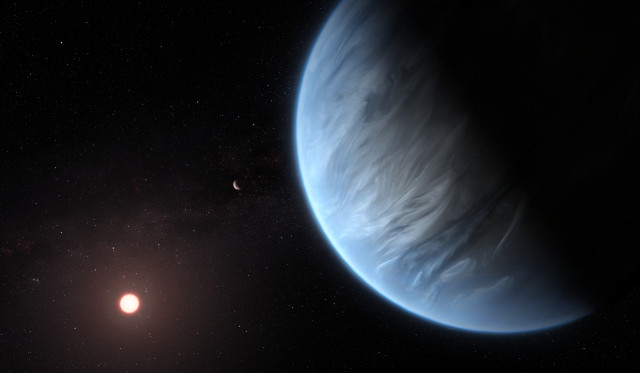
Artist's concept of K2-18b with its star in the background (Image ESA/Hubble, M. Kornmesser)

An article published in the journal “Nature Astronomy” reports the detection of water vapor in the exoplanet K2-18b’s atmosphere mainly thanks to the Hubble space telescope. This exoplanet is in ​​its system’s habitable zone and this made it interesting since this super-Earth was discovered in 2015. It’s the first detection of water vapor in an exoplanet of that type but it’s still too soon to assess its habitability potential because the detections are not precise enough to define the percentages of other molecules such as hydrogen and helium and to understand if there are clouds.

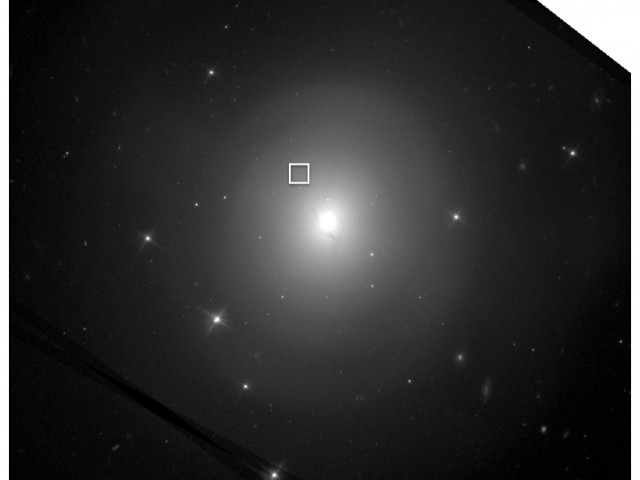
The afterglow of the event GW170817 in the inset (Image courtesy Wen-fai Fong/Northwestern University)

An article accepted for publication in “The Astrophysical Journal Letters” reports the results of the search for the afterglow of the merger between two neutron stars identified two years ago and cataloged as GW170817. It made history because it’s the first event of that type identified and was observed at both gravitational waves and electromagnetic waves. A team of researchers led by Wen-fai Fong of Northwestern University used the Hubble space telescope to detect the now very dim afterglow, the residual radiation after months of strong emissions.