2019

The vibrations of Saturn's rings used to reconstruct the impacts on the planet

An article published in “The Astrophysical Journal” reports a research on variations in the gravitational field of the planet Saturn due to internal vibrations. Yanqin Wu of the University of Toronto and Yoram Lithwick of Northwestern University used data collected by the Cassini space probe during its ring flybys to study the phenomenon, concluding that Saturn’s vibrations were caused by past impacts that made the planet sort of ring like a bell.

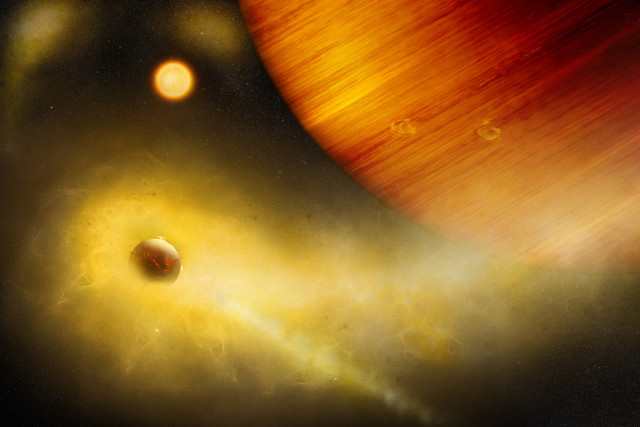
Artist's concept of an exo-Io orbiting a hot Jupiter (Image courtesy University of Bern. Illustration Thibaut Roger)

An article accepted for publication in “The Astrophysical Journal” reports on traces of sodium and potassium in the orbit of the gas giant exoplanet WASP-49b. A team of researchers coordinated by the Swiss University of Bern compared the situation of WASP-49b to Jupiter and its moon Io, known for its remarkable volcanic activity, noting that there are important clues to the fact that WASP-49b also has a volcanic moon with an activity that includes the ejection of sodium and potassium.

A gamma-ray burst from 2016 might have originated from a neutron star merger

An article published in the journal “Monthly Notices of the Royal Astronomical Society” reports a study on the short-duration gamma-ray burst cataloged as GRB160821B that has characteristics that match those of the merger of neutron stars observed at both electromagnetic waves and gravitational waves on August 17, 2017. A team of researchers led by Eleonora Troja of the University of Maryland used data collected from various telescopes to compare the two events and the 2016 one was observed since its early hours providing new information on the initial phase of what’s called a kilonova.

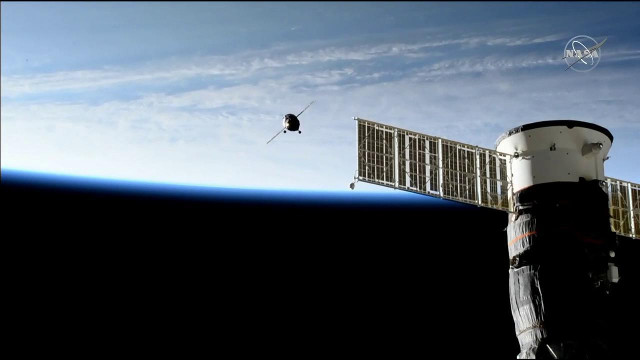
The Soyuz MS-14 spacecraft approaching the International Space Station. In the foreground the Soyuz MS-13 (Image NASA TV)

A few hours ago the Soyuz MS-14 spacecraft, which blasted off about last Wednesday from the Baikonur Cosmodrome in Kazakhstan, has reached the International Space Station. The integration test with the Soyuz 2.1a rocket was successful and the spacecraft reached its destination, even if it’s a few days late after the first docking attempt had to be aborted.