
2019

An article submitted for publication in the “Astrophysical Journal Letters” reports the discovery of eight repeating Fast Radio Bursts (FRBs). The CHIME/FRB collaboration, the team of scientists who use the CHIME radio telescope to search for these phenomena, gathered evidence of these new Fast Radio Bursts after the announcement of the second repeating one’s discovery months ago. This suggests that these phenomena are not so rare compared to non-repeating ones but that we have only recently found a way to detect them.

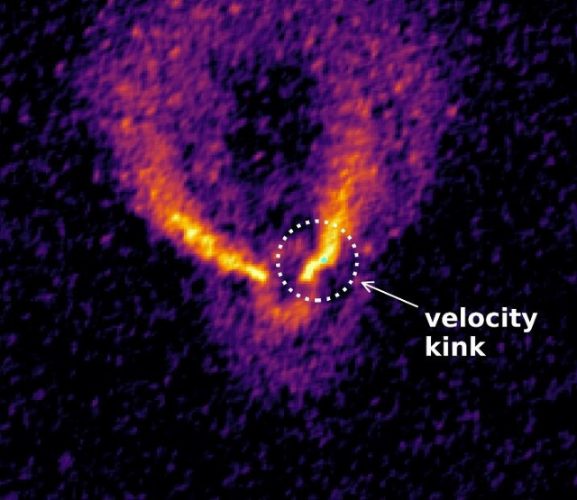
Planet's position pinpointed by the gas flow deviation (Image ESO/ALMA)

An article published in the journal “Nature Astronomy” reports the discovery of evidence of the existence of a planet in formation within the protoplanetary disk surrounding the star HD 97048. A team led by Christophe Pinte used a technique that was tested in a previous occasion that identifies areas where the flow of gas around a star is disturbed by the presence of a planet. The data collected using the ALMA radio telescope made it possible to identify a planet with a mass estimated between two and three times Jupiter’s.

The Vela Pulsar at the center of a nebula with the emission of a jet of particles (Image X-ray: NASA/CXC/Univ of Toronto/M.Durant et al; Optical: DSS/Davide De Martin)

An article published in the journal “Nature Astronomy” reports an analysis of an irregularity in the spin, a phenomenon called glitch in jargon, in the Vela Pulsar. A team of researchers led by Gregory Ashton of Monash University, Australia, analyzed the data collected by the Mount Pleasant Radio Observatory of the glitch detected on December 12, 2016. Probably this phenomenon is caused by internal interactions in the pulsar materials so studying it can provide information on the internal composition and on the processes taking place in an extreme object of this type.

39 ancestors of massive elliptical galaxies discovered in the early universe

An article published in the journal “Nature” reports the discovery of 39 galaxies in the early universe. A team of researchers combined data from different telescopes to identify a group of galaxies dating back to the first two billion years after the Big Bang that were invisible to previous observations in their areas conducted at optical frequencies. Their study could offer new information on the evolution of galaxies, on the supermassive black holes at their center and also on the distribution of dark matter.

A heavily obscured primordial supermassive black hole discovered

An article published in the journal “Astronomy & Astrophysics” reports the discovery of a supermassive black hole in an initial phase of growth in which it’s heavily obscured and that dates back to around 850 million after the Big Bang, the oldest of that type discovered so far. A team of researchers used data collected by NASA’s Chandra X-ray Observatory to carry out this study but even putting together other data collected with the ALMA radio telescope it’s not certain whether that black hole matches the quasar cataloged as PSO167-13 or a nearby galaxy.