2019

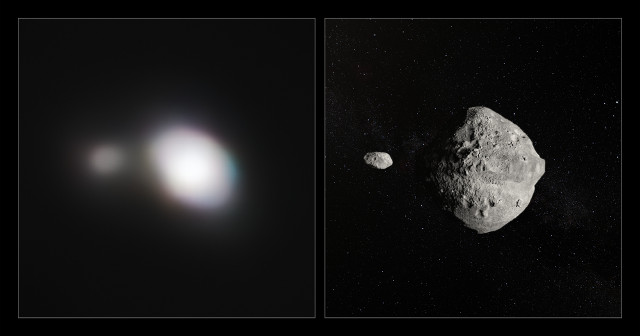
The asteroid 1999 KW4 photographed by the SPHERE instrument

ESO has published photos of the asteroid 1999 KW4 taken using the SPHERE instrument mounted on the VLT in Chile. This is part of a campaign of observations coordinated by the International Asteroid Warning Network (IAWN), which followed the UN recommendations to set up the control of potentially dangerous asteroids. 1999 KW4 passed 5.2 million kilometers from the Earth on May 25, 2019, an absolutely safe distance but it was a good opportunity to assess the possibility of keeping an eye on the trajectory of what’s actually a double asteroid even using an instrument designed to photograph exoplanets.

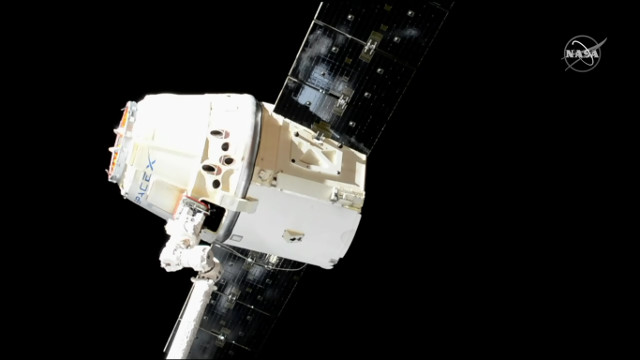
The Dragon cargo spacecraft departing the International Space Station to end its CRS-17 mission (Image NASA TV)

A few hours ago the SpaceX Dragon spacecraft ended its CRS-17 (Cargo Resupply Service 17) mission for NASA splashing down smoothly in the Pacific Ocean a little more than 325 kilometers (about 202 miles) off the coast of California. The Dragon left the International Space Station a few hours earlier.

Shortly after landing, SpaceX boats went to retrieve the Dragon to transport it to the coast. The cargo brought back to Earth will be delivered to NASA soon, probably tomorrow. The Dragon spacecraft reached the International Space Station on May 6, 2019.

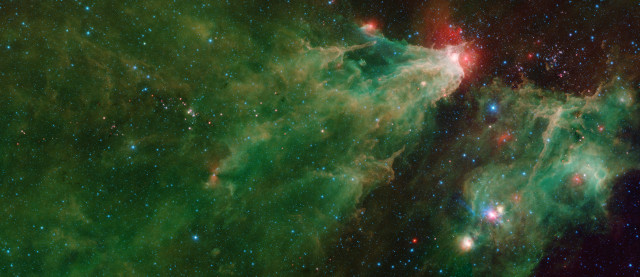
A stellar panorama between the Cepheus C and Cepheus B regions

An article published in “The Astrophysical Journal” reports a study of an area containing a number of star clusters that have a common origin even if their formation had slightly different timescales in the various regions. A team of researchers used NASA’s Spitzer space telescope and Chandra X-ray Observatory to examine the many different objects present between the regions known as Cepheus C and Cepheus B and map the cluster called Cep OB3b.

Artist's concept of the exoplanet NGTS4b and its star (Image courtesy University of Warwick/Mark Garlick)

An article published in the journal “Monthly Notices of the Royal Astronomical Society” reports the discovery of an exoplanet belonging to the mini-Neptune class in an orbit close to its star, where a planet of that type should not exist, so much that it’s called Neptunian Desert. A team of astronomers coordinated by the University of Warwick used the Next-Generation Transit Survey (NGTS) array in Chile to locate the exoplanet, which was therefore cataloged as NGTS-4b. It may have got closer to its star or was originally larger but part of its atmosphere was consumed by stellar radiation.

Nakhla meteorite (Photo NASA)

An article published in the journal “Geochimica et Cosmochimica Acta” reports the evidence that on the planet Mars there were hydrothermal springs and an atmosphere much thicker than the current one until just over a billion years ago. A team of researchers led by planetary geologist Nicola Mari of the University of Glasgow studied 5 of the 20 Martian meteorites from the group of nakhlites identified on Earth, analyzing in particular sulfur isotopes finding traces of hydrothermal springs and a thick atmosphere of up to about 1.3 billion years ago. An environment capable of sustaining life forms similar to the the Earth’s still existed at that time, more than two billion later than previously thought.