2019

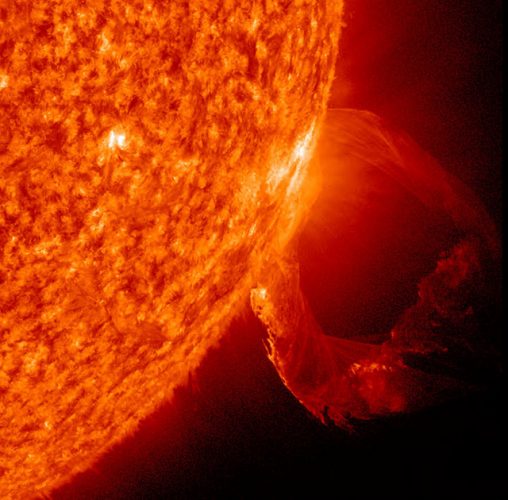
A solar eruption (Image SDO/NASA)

An article published in the journal “Nature Astronomy” reports the observation of a huge coronal mass ejection (CME), a huge stellar eruption in which an enormous amount of materials is thrown out, by the star HR 9024. A team of researchers led by Constance Argiroffi of the University of Palermo and associated of the National Institute of Astrophysics used data collected by NASA’s Chandra X-ray Observatory to find traces of the ejection of a mass about 10,000 times greater than that of the most powerful events of that kind generated by the Sun.

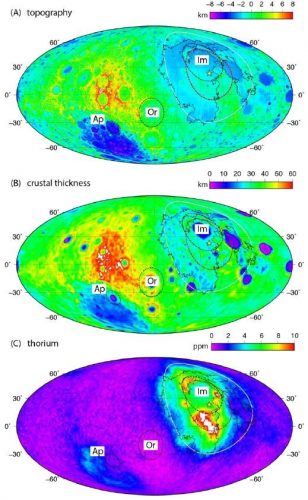
The differences between the two faces of the Moon could be due to the impact of a dwarf planet

An article published in the “Journal of Geophysical Research: Planets” reports the results of computer simulations generated to explain the asymmetry of the two faces of the Moon. A team of researchers used data from NASA’s GRAIL mission as a reference to try to reproduce the Moon’s situation, concluding that the best explanation comes from the simulation of the impact of a dwarf planet with a diameter of about 780 kilometers on the current Earth-facing Moon’s side at about 22,500 km/h.

60 Starlink satellites blasting off a Falcon 9 rocket (Image courtesy SpaceX)

A few hours ago 60 satellites of the Starlink constellation were launched on a Falcon 9 rocket from Cape Canaveral. After just over an hour they were successfully deployed into their orbit at an altitude of about 440 kilometers all together and then started slowly disperse. This is SpaceX’s first mission to put the Starlink constellation into orbit to provide a global Internet connection coverage.

New clues to the origin of fast radio bursts in neutron stars

An article published in the journal “Astronomy & Astrophysics” reports a study of the data about 43 fast radio bursts (FRBs) that offers new clues to their origin in neutron stars. A team of Italian researchers associated with the National Institute of Astrophysics used observations made with the ASKAP and Parkes radio telescopes, adapting a test from the 1960s to try to establish their distribution by comparing it with that of stars. The results gave some surprises and are not conclusive, but a method was offered that could be the key to solving the mystery for good.

A possible underground ocean on Pluto could be protected by an insulating layer

An article published in the journal “Nature Geoscience” reports the results of a study of the conditions that could allow the presence of an ocean below the dwarf planet Pluto’s surface. A team of researchers analyzed using computer simulations the possibility that under the heart-shaped area called Sputnik Planitia there’s a layer of gas hydrate of the class known as clathrates formed by water and natural gas which acts as an insulator allowing the layer below them it remains warm enough to keep water in its liquid state.