2019

Traces of an ancient river system on Mars

ESA has published some images of an ancient system of trenches and river valleys near a large crater with a diameter of over 450 kilometers north of the great Hellas Planitia basin on the planet Mars obtained thanks to the Mars Express space probe’s High Resolution Stereo Camera (HRSC). The signs of water flow are mixed with the craters caused by impacts occurred between 3.5 and 4 billion years ago in that area of ​​the Martian southern hemisphere showing the different processes that were taking place when the red planet was young and much more similar to the Earth.

Circular features and pits on Ultima Thule

NASA and The Johns Hopkins University Applied Physics Laboratory have published some photos of the Kuiper belt object cataloged as 2014 MU69 and nicknamed Ultima Thule taken by the New Horizons space probe’s LORRI camera only six minutes before its maximum approach. At only 6,628 kilometers (4,109 miles) from it and at its very high speed there was the risk of not being able to perfectly aim at a such a small object but the operation was successful.

The Beresheet lander blasting off atop a Falcon 9 rocket (Image courtesy SpaceX)

A few hours ago a Falcon 9 rocket blasted off from the Cape Canaveral base with the telecommunications satellite PSN 6 and as secondary payloads the S5 military satellite and SpaceIL’s Beresheet Moon lander. After almost 35 minutes, Beresheet separated from the rocket’s last stage of the rocket to begin the series of maneuvers that will slowly extend its orbit to bring it to the area of ​​influence of the Moon, where it’s to land around April 11.

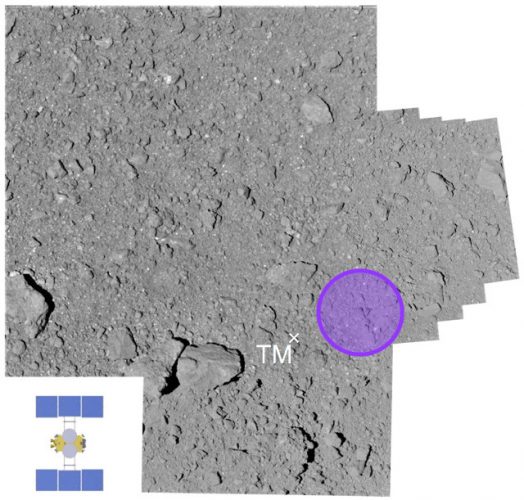
The L08-E1 area on asteroid Ryugu touched by Hayabusa 2 (Image courtesy JAXA)

A few hours ago, the Japanese space probe Hayabusa 2 touched down on the soil of asteroid Ryugu to collect some samples of regolith, the soil’s surface layer, which will be transported back to Earth. This is the first of the three possible attempts and now the Japanese space agency JAXA will have to assess whether to look for another area on the asteroid and proceed with a second attempt.

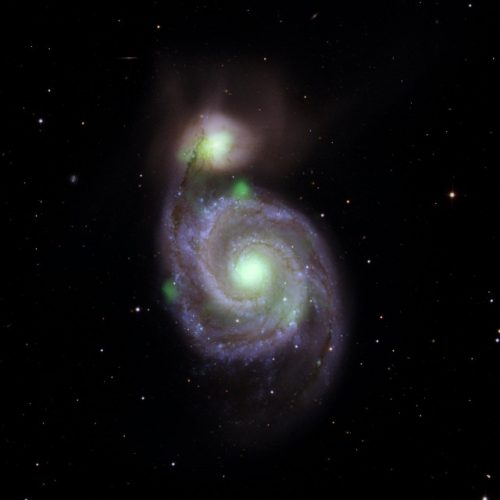
Surprising high-energy X-ray emissions from the Whirlpool Galaxy and its small companion

An article published in “The Astrophysical Journal” presents an in-depth spectral analysis of the two active galactic nuclei and other X-ray sources of the two galaxies that form M51. A team of researchers used NASA’s NuSTAR space telescope to detect high-energy X-ray emissions, which can pass through the layers of dust and gas that orbit the two supermassive black holes at the center of the two galaxies that are interacting in an initial phase of a galactic merger. A surprise came from the emissions of a neutron star in the Whirlpool Galaxy, the larger of the pair.