2019

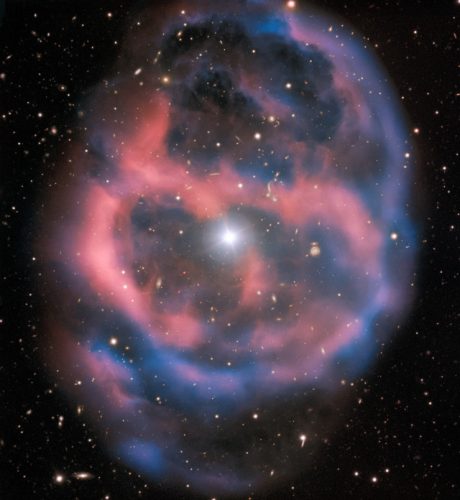
The planetary nebula ESO 577-24 seen in all its beauty by the Very Large Telescope

ESO has published a new image of the planetary nebula ESO 577-24 captured by its Very Large Telescope (VLT) in Chile thanks to its FORS2 instrument, which for almost twenty years has been capturing some of the best astronomical images obtained by the VLT. ESO 577-24 represents the final phase of the life of the star at its center, cataloged as Abell 36, in astronomical terms an instant of agony since its duration is estimated around 10,000 Earth years.

Close-up of Saturn's rings (Image NASA/JPL-Caltech/Space Science Institute)

An article published in “The Astrophysical Journal” reports a precise measurement of the duration of the day on the planet Saturn. The lack of a solid surface with reference points and a magnetic field with unusual characteristics prevented precise measurements, but now a team of researchers led by Christopher Mankovich of the University of California, Santa Cruz, (UCSC) accomplished that feat by exploiting data collected by the Cassini space probe on the effects that the vibrations inside Saturn cause on the oscillation of its gravitational field and consequently also on the rings. The result is that the day on the planet was measured in 10 hours, 33 minutes and 38 seconds.

Evidence of methane rains on Saturn's great moon Titan's north pole

An article published in the journal “Geophysical Research Letters” reports evidence of rainfall on Titan, the largest of Saturn’s moons. A team of researchers led by Rajani Dhingra, a doctoral student in physics at the University of Idaho, examined images captured by the Cassini space probe, finding an anomaly at the north pole of Titan interpreted as a methane rain. This is an indication of the beginning of summer in this moon’s northern hemisphere.

New estimates of Saturn's characteristics include the age of its rings

An article published in the journal “Science” describes a research on the planet Saturn that includes an analysis of its internal structure but also on its evolution, which includes its rings’. A team of researchers led by Luciano Iess of the Sapienza University of Rome, Italy, used data collected by the Cassini space probe to determine that the winds on Saturn reach a depth of about 9,000 kilometers and that the rings were formed not more than 100 million years ago.

A rare hypernova shows the possible death of a very massive star

An article published in the journal “Nature” reports the observation of a gamma-ray burst (GRB) cataloged as GRB 171205A associated with a supernova cataloged as SN 2017iuk that was tens of times brighter than that type of event generally is, so as to fall into the category of hypernovae. A team of astronomers led by Luca Izzo of the Instituto de AstrofĂ­sica de AndalucĂ­a (IAA-CSIC) detected for the first time interaction between the jet that caused the GRB and the outer layers of the exploded star. This allowed to better understand the mechanisms that combine hypernovae and gamma-ray bursts, connected to a “hot cocoon”.