2019

SN 2015 cp is a rare type Ia supernova

An article accepted for publication in “The Astrophysical Journal” reports the discovery of a type Ia supernova, cataloged as SN 2015 cp. A team of astronomers led by Melissa Graham of the University of Washington used observations made with the Hubble Space Telescope and others to study a binary system in which a star that could be a red giant ejected huge amounts of materials and a part reached its companion, a white dwarf, causing its explosion.

The Dragon cargo spacecraft departing the International Space Station to end its CRS-16 mission (Image NASA TV)

A little while ago the SpaceX Dragon spacecraft ended its CRS-16 (Cargo Resupply Service 16) mission for NASA splashing down smoothly in the Pacific Ocean a little more than 420 kilometers (about 326 miles) off the coast of California. The Dragon left the International Space Station a few hours earlier.

Shortly after landing, SpaceX boats went to retrieve the Dragon to transport it to the coast. The cargo brought back to Earth will be delivered to NASA soon, probably tomorrow. The Dragon spacecraft reached the International Space Station on December 8, 2018.

A cosmic explosion has different interpretations

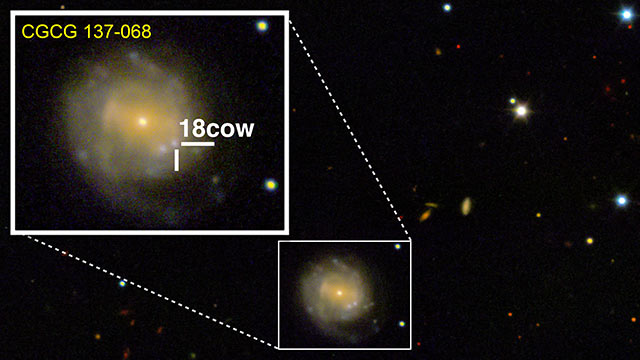
Two articles, one to be published in the journal “The Astrophysical Journal” and one in the journal “Monthly Notices of the Royal Astronomical Society”, describe studies of an anomalous event and an object cataloged as AT2018cow and therefore nicknamed “The Cow”. According to a team led by Raffaella Margutti of Northwestern University, who produced the article to be published in “The Astrophysical Journal”, it could be an anomalous supernova, tens of times brighter than normal that generated a black hole or a neutron star, while another team led by Paul Kuin of University College London (UCL), who produced the article to be published in “Monthly Notices of the Royal Astronomical Society”, it could be a black hole that destroyed a star.

Brightest quasar in the early universe discovered

An article published in the journal “Astrophysical Journal Letters” reports the discovery of the brightest quasar in the early universe. A team of researchers used observations of the Hubble Space Telescope and some ground-based telescopes to identify the galaxy cataloged as J043947.08+163415.7 at a distance of about 12.8 billion light years from the Earth. The supermassive black hole at its center is surrounded by a lot of materials that emit the huge amount of light that allows it to be identified even at that enormous distance, but only thanks to a gravitational lensing effect. That activity dates back almost a billion years after the Big Bang.

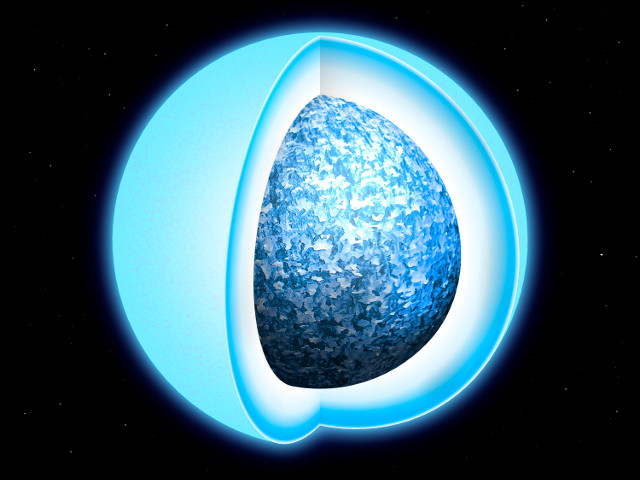
Artist’s impression of crystallisation in white dwarf (Image courtesy University of Warwick/Mark Garlick. All rights reserved)

An article published in “Nature” shows the evidence that in white dwarfs oxygen and carbon slowly crystallize from their cores. A team of researchers used data collected by ESA’s Gaia space probe that include distance, brightness and color of hundreds of thousands of white dwarfs analyzing over 15,000 candidates within 300 light years away from Earth to collect evidence of the crystallization process. This is the first verification of a prediction dating back to the beginning of the 1960s.