2019

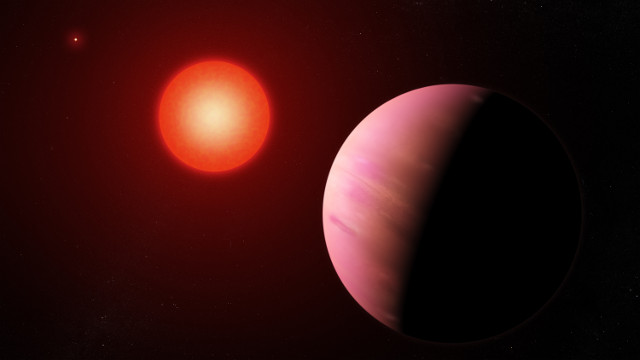
Artist's concept of the exoplanet K2-288Bb with its star and the other red dwarf far away (Image NASA's Goddard Space Flight Center/Francis Reddy)

An article published in the journal “The Astronomical Journal” describes the study of the exoplanet K2-288Bb, discovered among the observations made by NASA’s Kepler space telescope with the help of citizen scientists thanks to the Exoplanet Explorers project. Adina Feinstein, a University of Chicago graduate student and lead author of the paper, presented the results at the 233rd meeting of the American Astronomical Society in Seattle held in Seattle.

A verification of dark matter heating

An article published in the journal “Monthly Notices of the Royal Astronomical Society” reports confirmations to the hypothesis of the effect known as dark matter heating. A team of researchers looked for the effects of the presence of dark matter in dwarf galaxies relatively close to the Milky Way, finding the confirmation that star formation can heat it causing it to move outwards. It’s a new possibility to study dark matter to try to understand its nature.

Ultima Thule offers the first answers but leaves many questions open

In a press briefing that included a number of scientists working on NASA’s New Horizons mission, the first discoveries on the Kuiper Belt object cataloged as 2014 MU69 and nicknamed Ultima Thule were presented, obtained thanks to data received during the January 1, 2019 flyby. They’re based on information that’s still incomplete, which could be contradicted by high resolution photos and other data but for the moment this object doesn’t appear to have neither moons nor rings, or at least not of relevant sizes, no impact craters were found on its surface nor were traces of atmosphere.

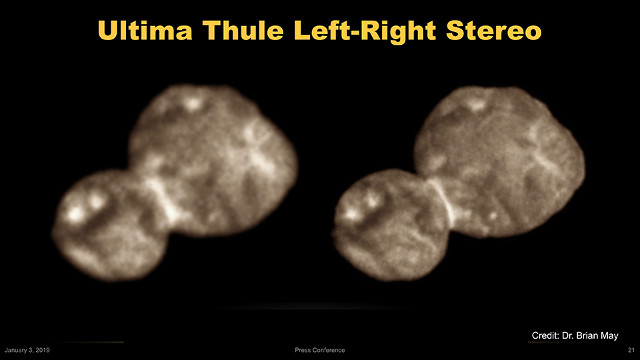
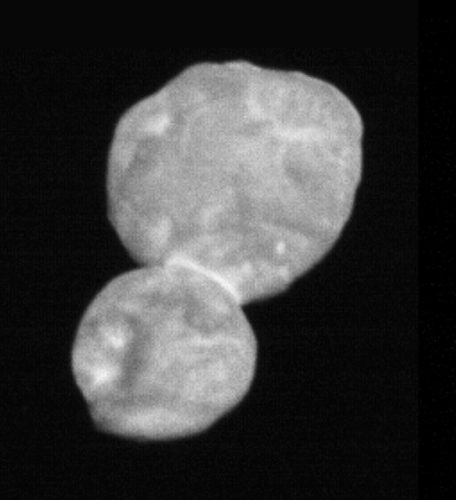
Ultima Thule is made up of two smaller asteroids

NASA published the first detailed images of the Kuiper Belt object cataloged as 2014 MU69 and nicknamed Ultima Thule. Captured by the New Horizons space probe’s LORRI and MVIC instruments approximately 90 to 30 minutes before its closest approach, they finally clearly show this object’s double-lobe structure. In jargon, it’s called a contact binary and is the result of two close objects that collide at low speed and end up merging. The larger lobe has been nicknamed Ultima and the smaller Thule.

Photo of the Moon's area where the Chang'e-4 mission landed (Photo courtesy China national space administration)

The China national space administration has confirmed that the lander and the rover of its Chang’e-4 mission have landed on the hidden face of the Moon today at 2.26 GMT. In the past various space probes took photos of the hidden face from the orbit, but these are the first vehicles that land there. The mission began on December 7 with the launch of the spacecraft that contains lander and the rover.