2019

Titan's dunes (Image courtesy University of Hawaii at Manoa)

An article published in the journal “Science Advances” reports a study that offers some answers to the mystery of the origin and composition of the dunes on Titan, one of the moons of the planet Saturn particularly interesting for many reasons that include the formation of many organic compounds. A team of researchers led by physical chemist Ralf I. Kaiser of the University of Hawaii at Manoa examined data collected during the Cassini-Huygens mission and computer simulations whose results indicate that acetylene exposed to cosmic rays can form materials that make up Titan’s dunes.

Artist's concept of MAXI J1820+070's system (Image courtesy John Paice)

An article published in the journal “Monthly Notices of the Royal Astronomical Society” reports a study of the black hole MAXI J1820+070, part of an X-ray binary system that includes a normal star to which the black hole steals gas. A team of astronomers coordinated by the British University of Southampton used the HiPERCAM and NICER instruments to detect visible light and X-rays respectively emitted during an outburst activity in 2018. The data collected were used to create a video slowed down ten times to allow astronomers to see the fastest flares and examine the details of that activity.

Artist's concept of a quasar (Image ESO/M. Kornmesser)

An article published in the journal “Astronomy & Astrophysics” reports an analysis of 48 quasars in the early universe to detect the outflows of materials they produce. A team of researchers led by Manuela Bischetti of the Italian National Institute of Astrophysics in Rome used the ALMA radio telescope to confirm for the first time the common existence of those outflows, which act as powerful winds inside those early galaxies heavily interfering in the formation of new stars.

Two disks that rotate in opposite directions around the supermassive black hole at the center of the galaxy NGC 1068

An article published in the journal “The Astrophysical Journal” reports the discovery of a supermassive black hole at the center of the galaxy NGC 1068 surrounded by two gas disks that rotate in opposite directions. A team of researchers led by Caterina Maria Violette Impellizzeri of the National Radio Astronomy Observatory (NRAO) used the ALMA radio telescope to observe the center of that galaxy in sufficient detail to detect the two disks and their motions. That situation is not very stable and in the future a collision between the two rings could generate an abundant meal for the black hole. That’s a possible quick growth mechanism for supermassive black holes.

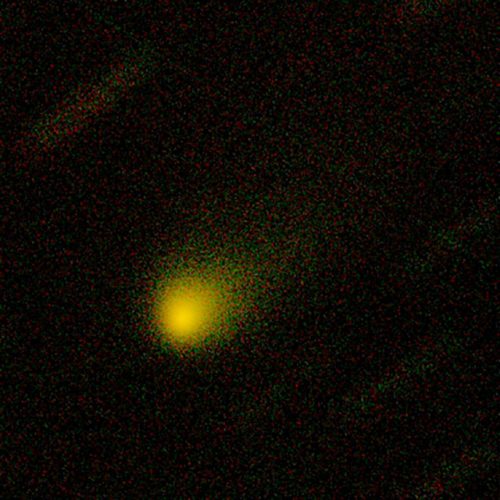
Interstellar comet 2I/Borisov (Image courtesy Gemini Observatory/Nsf/Aura)

An article published in the journal “Nature Astronomy” reports an initial characterization of interstellar comet 2I/Borisov, initially designated as C/2019 Q4. A team of researchers used data collected using the Gemini North on the island of Mauna Kea, in Hawaii, and the William Herschel Telescope in the Canaries. The data confirm it comes from another star system, yet it has characteristics very similar to the comets of the solar system.