An article published in the journal “Monthly Notices of the Royal Astronomical Society” reports a study on the blazar CTA 102. A team of researchers used data that cross the electromagnetic spectrum from radio waves to gamma rays detected by a series of space and ground-based telescopes. They allowed to monitor the variability of CTA 102 between 2013 and 2017 and events such as the significant activity of gamma ray emissions between November 2016 and February 2017, with outbursts on four occasions with a peak reached on December 28, 2016.
Blazars are extreme objects even by the standards of active galactic nuclei with jets of materials ejected at speeds close to the speed of light aligned with the Earth. Blazar jets have emission peaks between radio waves and X-rays and high-energy gamma rays. The processes leading to gamma-ray emissions are still at the center of discussions, what’s certain is that emissions at various wavelengths are variable in ways at least for now unpredictable. To try to understand the physical mechanisms in place, astronomers are conducting long-term observations across different bands of the electromagnetic spectrum.
The blazar CTA 102 was discovered in the 1960s and its variable radio emissions raised considerable interest from the start because at the time the instruments available to astronomers were unable to identify their source. Monitoring these emissions led astrophysicist Nikolai Kardashev to theorize that they were emissions generated by an extraterrestrial civilization and only years later it was possible to establish that CTA 102 was a type of quasar. Its monitoring continued due to the scientific interest that still existed around this object and improved over the decades.
NASA’s Compton Gamma Ray Observatory (CGRO), launched in 1992, made it possible to discover that the blazar CTA 102 also has variability in gamma rays and NASA’s Fermi space telescope, launched in 2008, allowed continuous monitoring of this object. Other observatories made it possible to monitor other electromagnetic bands, from the optical, ultraviolet and X-ray bands of the Swift space telescope to radio waves thanks to the ALMA radio telescope.
In November 2016, the blazar CTA 102 started an extraordinary gamma ray activity, with four periods of outbursts reaching a peak where its brightness was 250 times higher than normal. The monitoring of many different observatories in the various electromagnetic bands made it possible to detect the variations offering some clues about the processes in progress and the mechanisms at their origin.
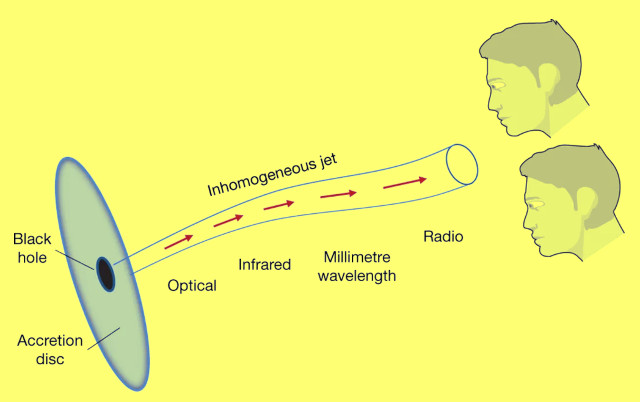
The researchers explored the possibility that the jet oriented towards the Earth actually has a certain variability in its orientation, confirming a theory already exposed by another team in an article published in the journal “Nature” in December 2017. The bottom image (Courtesy CM Raiteri et al., Nature. All rights reserved) illustrates that inhomogeneous jet model.
This latest research might not be the final answer because there are possibilities at this moment impossible to verify such as the presence of two supermassive black holes that power the blazar and are about to merge. It’s therefore likely that the blazar CTA 102 will still be the focus of more research.