An article published in the journal “Astronomy & Astrophyiscs” reports the mapping of the distribution and motion of hot gas within the Perseus and Coma galaxy clusters. A team of researchers led by Jeremy Sanders of the Max Planck Institute for extraterrestrial physics in Garching, Germany, used in particular ESA’s XMM-Newton space telescope to study those two large clusters and detect the gas that, at very high temperatures and in the form of a plasma, shines at X-rays. This mapping offers new information on the formation and evolution of galaxy clusters.
The Perseus galaxy cluster, also known as Abell 426, is relatively close, 240 million light years from Earth, and spans approximately 11 million light years. It’s the most brilliant X-ray object known and for this reason it has already been the subject of studies such as the one reported in an article published in the journal “Monthly Notices of the Royal Astronomical Society” in May 2017 which described the discovery of a vast wave of hot gas inside it that extends for about 200,000 light years.
The Coma galaxy cluster, also known as Abell 1656, is about 350 million light years from Earth and is made up of over a thousand galaxies, mainly of the elliptical type. In the 1930s it was one of the first objects in which observations indicated that the visible mass was too low for the gravitational effects detected. According to recent estimates, about 90% of this cluster’s mass is made up of dark matter. X-ray sources have been detected within it over the decades.
X-rays sources can be of various types but the ones covered by this study are made up of extremely hot gas, to the point of being in the form of plasma. Our knowledge of the movements of that plasma is very limited but could be a key to understanding how galaxy clusters form, evolve and behave. To obtain information on that plasma, Jeremy Sanders’ team devised a new calibration technique applied to the XMM-Newton space telescope’s EPIC (European Photon Imaging Camera) instrument. Reviewing two decades of data collected by EPIC improved the accuracy of its velocity measurements by a factor of over 3.5, taking XMM-Newton’s capabilities to a new level.
In mapping the gas of the Perseus and Coma clusters, the researchers exploited the so-called fluorescent lines that are always present in the EPIC instrument’s observations. It’s a background signal that was considered useless but by using it to compare and align the data of the last twenty years it was possible to use it to correct variations and instrumental effects. This allowed to reach the new level of accuracy.
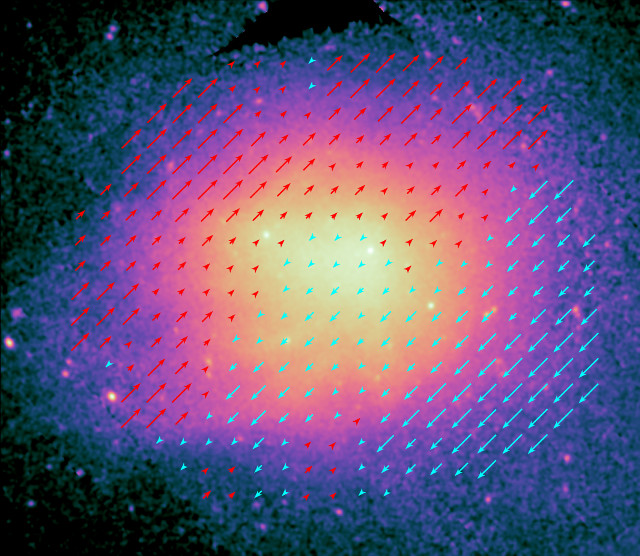
The top image (ESA/XMM-Newton/J. Sanders et al. 2019) shows the Perseus cluster observed at X-rays by the XMM-Newton space telescope’s EPIC instrument. The central region is very bright and has the highes density. The arrows indicate the direction and intensity of the gas movements in the cluster. The red arrows indicate the areas where the gas is moving away from us, the ones in blue indicate the areas where the gas is moving towards us. The length of the arrows is directly proportional to the gas velocity.
The researchers also conducted simulations of the plasma movement to try to better understand its causes. There are probably colliding sub-clusters in the Perseus cluster that are merging with the main one. The energies of these events change the cluster’r gravitational field and generated the gas movements, which could continue for many millions of years.
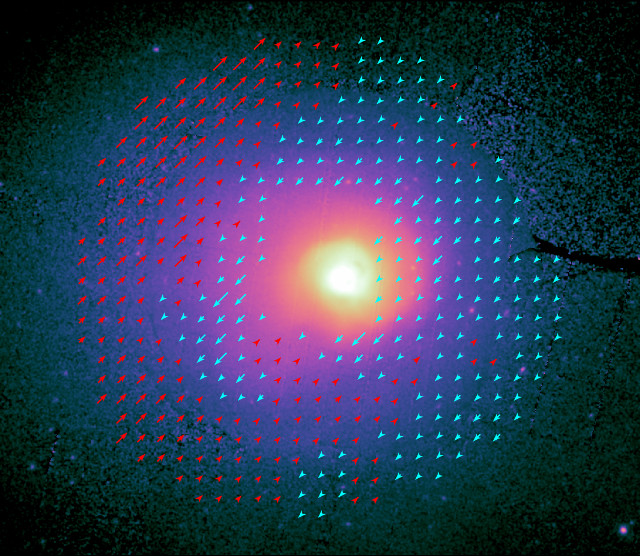
The situation in the Coma cluster is different because the plasma movements don’t seem to be caused by gravitational perturbations generated by its galaxies. This cluster appears to consist of two large sub-clusters that are slowly merging, a less chaotic situation than the one in the Perseus cluster.
The bottom image (ESA/XMM-Newton/J. Sanders et al. 2019) shows the Coma cluster observed at X-rays by the XMM-Newton space telescope’s EPIC instrument. The bright central region is very large with a density that remains quite even. The arrows indicate the direction and intensity of the gas movements in the cluster. The red arrows indicate the areas where the gas is moving away from us, the ones in blue indicate the areas where the gas is moving towards us. The length of the arrows is directly proportional to the gas velocity.
This study paves the way for further processing of data collected by the XMM-Newton space telescope that will offer new information on other galaxy clusters. In 2031 the launch of the new ESA space telescope for X-ray astronomy, Athena (Advanced Telescope for High-ENergy Astrophysics), is scheduled. In the meantime many studies can take advantage of the new calibration technique of the EPIC instrument.