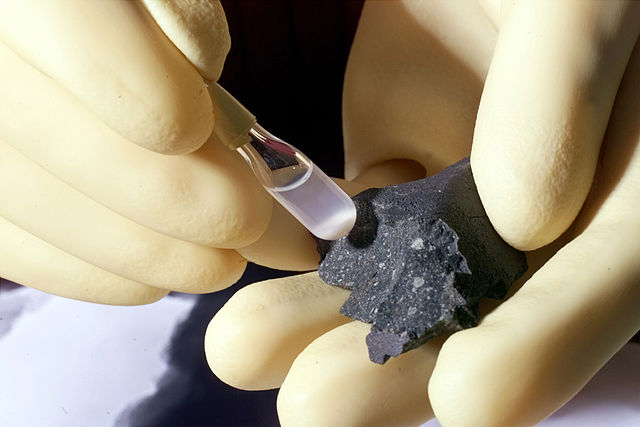
An article published in the journal “Proceedings of the National Academy of Sciences” reports the dating of grains of silicon carbide that were part of the Murchison meteorite, which date back to different times with the oldest one dating back about 7 billion years ago. A team of researchers led by Philipp Heck of the University of Chicago analyzed particles contained in the Murchison meteorite by examining the elements contained and in particular the neon isotopes produced by galactic cosmic rays that struck those grains over time.
The Murchison meteorite is a so-called carbonaceous chondrite which fragmented over the Australian sky on September 28, 1969. Many fragments fell near the village of Murchison and were subsequently recovered for a total mass of around 100 kg. Over the years, its study raised interest also because it contained over 100 amino acids and other organic compounds, some of which are linked to life such as the nucleotides xanthine and especially uracil, one of the RNA nucleobases.
Now the team led by Philipp Heck, an associate professor at the University of Chicago and curator at the Field Museum, performed an analysis of grains trapped in the Murchison meteorite to date them. The method is very different from those used in other fields, such as those based on radioisotopes, because it’s not possible to know the initial isotopic composition of objects arrived from space. They were formed who knows where by collecting fragments here and there across the solar system that can be arrived from who knows where. For this reason, dating is based on the fact that meteorites are exposed to the action of cosmic rays, which can generate new elements by interacting with those of the meteorite that got struck.
In the case of the Murchison meteorite, the researchers took grains of silicon carbide and analyzed the presence of neon-21, an element formed by the action of galactic cosmic rays. The result is that most of the grains were between 4.6 and 4.9 billion years, but some were older than 5.5 billion years with a peak of 7 billion years, far older than the solar system.
This dating offers clues to cosmic events that occurred before the formation of the solar system. Those grains so ancient were formed with the death of ancient stars, which ejected materials of various types during their agony. Those materials traveled for who knows how long ending up in the protoplanetary disk that formed the solar system and getting absorbed in meteorites such as Murchison.
Using the grain dating, the researchers tried to make some hypotheses about the formation of stars in the cosmic neighborhood. Philipp Heck stated that there are still a lifetime of questions to be answered, but this study offers interesting information that could spur further research.