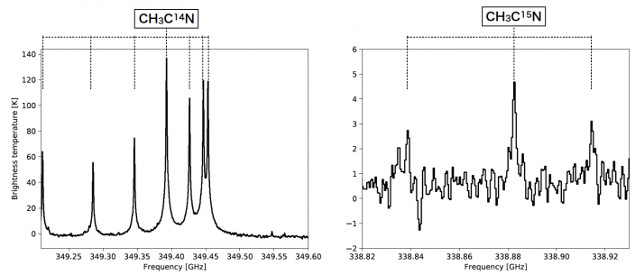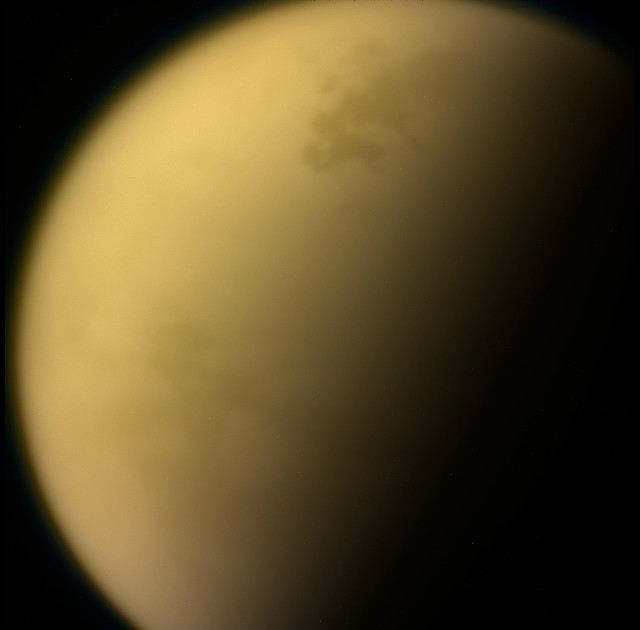
An article published in “The Astrophysical Journal” reports a study of the chemical compounds in the atmosphere of Titan, Saturn’s great moon. Takahiro Iino of the University of Tokyo, together with Hideo Sagawa of Kyoto Sangyo University and Takashi Tsukagoshi of NRAO (National Astronomical Observatory of Japan) used the ALMA radio telescope to detect the chemical signatures of the compounds existing on Titan discovering that of acetonitrile, including a rare isotopomer that contains nitrogen-15.
For many years astronomers and astrobiologists have been studying Titan after the discovery that this moon has an atmosphere and hydrocarbon lakes with a growing interest after the progressive discovery of complex chemical reactions. It’s an environment in some ways very different from the Earth’s and at the same time curiously similar that produced research with hypotheses on possible life forms based on a truly exotic biochemistry. There are no confirmations of these hypotheses but the evidence indicates the existence of a prebiotic environment.
The ALMA (Atacama Large Millimeter/submillimeter Array) radio telescope, inaugurated in March 2013, has the power and sensitivity needed to detect the signatures of chemical compounds in Titan’s atmosphere and for this reason it’s already been used several times for studies of this type with interesting results. An article published in July 2017 in the journal “Science Advances” reported the detection of vinyl cyanide molecules, which under the conditions existing on Titan is considered among the best candidates for the formation of membranes and vesicles similar to those of the Earth’s organisms cells.
In this new research, the detections concerned weak traces of acetonitrile, a molecule that in organic synthesis can be a building block of more complex compounds. In Titan’s atmosphere, chemical processes occur mainly thanks to ultraviolet rays from the Sun and cosmic rays from outside the solar system.
The various interactions are especially important with regards to nitrogen-bearing molecules because ultraviolet light destroys the nitrogen molecules containing the nitrogen-15 isotope, which are therefore rare. The specific wavelength ultraviolet that interact with the nitrogen-14 molecules are easily absorbed in the upper atmosphere. On the other hand, cosmic rays penetrate deeper and interact with molecules that contain only nitrogen-14. The researchers found that the nitrogen-14 isotope is more abundant in acetonitrile found in the stratosphere than in other nitrogen-bearing molecules found in the past.
The bottom image (Courtesy Iino et al. (The University of Tokyo). All rights reserved) shows the spectra of acetonitrile containing nitrogen-14 and nitrogen-15 detected by the ALMA radio telescope in Titan’s atmosphere. The vertical dotted lines indicate the frequencies of the emission lines predicted by a theoretical model, which found a good match in the data collected.
Hideo Sagawa stated that he and his colleagues suppose that galactic cosmic rays play an important role in the atmospheres of other bodies. The process could be universal, so understanding the role of cosmic rays on Titan is crucial for planetary science in general.
The results of this new study add another molecule to the long list of chemical compounds existing on Titan and to the various chemical reactions that take place on that moon. In this case, however, the implications are also interesting for research on exoplanet atmospheres, a field of research in considerable expansion.