
An article published in the journal “Nature Astronomy” reports a study on the abundance of water in the atmosphere and in particular in the equatorial region of the planet Jupiter. NASA’s Juno mission team used data collected by the space probe, which has been orbiting the gas giant for about 3.5 years. The conclusion is that water makes up about 0.25% of the molecules in Jupiter’s atmosphere, about three times those present in the Sun’s atmosphere estimated through the presence of its components. This is a result that indicates an abundance much higher than that measured in 1995 by the Galileo space probe.
The Juno space probe entered the planet Jupiter’s orbit on July 4, 2016 with the aim of giving answers to the many questions still existing about this gas giant. One question concerns the amount of water present in its atmosphere, which would be useful to better understand its formation processes and to obtain answers also on certain phenomena taking place on Jupiter such as wind flows and its internal structure.
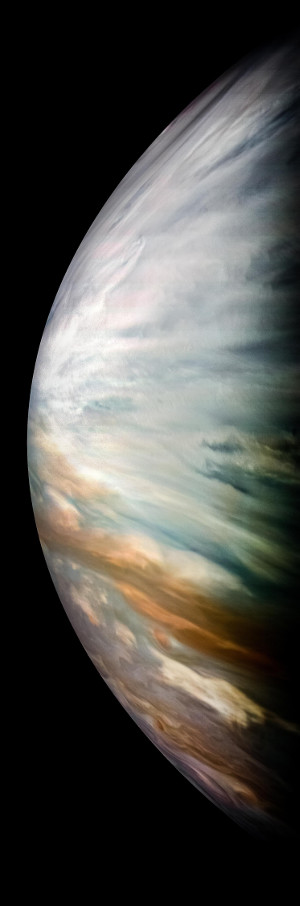
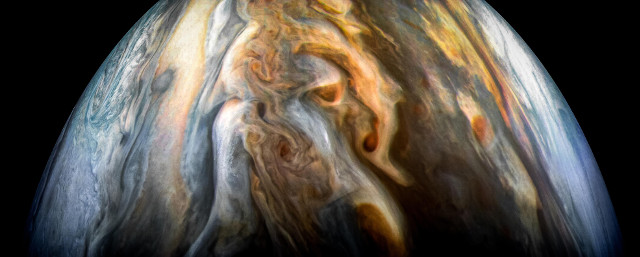
The top image (NASA/JPL-Caltech/SwRI/MSSS/Kevin M. Gill) shows the planet Jupiter’s equatorial region photographed on September 1, 2017 by the Juno space probe’s JunoCam. Jupiter’s poles are not visible and run left to right. The side image (NASA/JPL-Caltech/SwRI/MSSS/Kevin M. Gill) shows thick white clouds in Jupiter’s equatorial area captured by JunoCam on December 16, 2017.
One of the problems in estimating the amount of water in Jupiter’s atmosphere comes from the measurement made by the Galileo space probe at the end of its mission. During its descent into the planet’s atmosphere, which took place in December 1995, it sent data up to a depth of about 120 kilometers indicating that water is really scarce, even ten times less than expected. That amount seems to increase with depth with an apparent contradiction of theoretical models. By combining Galileo’s data with infrared observations conducted at the time with a ground-based telescope, the results suggest that the probe may have collected its data in an area that’s drier and warmer than normal.
The variability of the presence of water in Jupiter’s atmosphere remains an enigmatic element and to try to understand it, the Juno mission team used the data collected thanks to the MWR (Microwave Radiometer) instrument, which uses six antennas to measure atmospheric temperature at multiple depths simultaneously. MWR takes advantage of the fact that water absorbs certain microwave wavelengths, the same ones used in ovens, as ammonia does. The data used were collected by Juno during its first 8 Jupiter flybys, reaching depths greater than Galileo with MWR reaching up to about 150 kilometers.
The researchers focused on the planet Jupiter’s equatorial region, where the atmosphere seems well mixed, even in depth, compared to other regions. It’s a unique region, so they’ll need to compare the results obtained with those of other regions. The indication that water makes up 0.25% of the molecules present in Jupiter’s atmosphere may not be confirmed in other regions.
The orbit of the Juno space probe gets modified to try to get passages over the entire surface of Jupiter and now the planet’s northern hemisphere is the best covered one. The 24th flyby was conducted on February 17 so the mission team members will have new data to analyze also regarding the presence of water. Approaching the north pole, the influence of polar cyclones increases, another factor to keep in mind when researching a planet that keeps on revealing new information.
