Two articles – available here and here – published in “The Astrophysical Journal” report the study of a total of over 300 protostars with their protoplanetary disks in the Orion Complex, a group of molecular clouds that are perfect nurseries for the birth of new stars. A team of researchers led by John Tobin of the National Radio Astronomy Observatory (NRAO) used the data collected by the VLA and ALMA radio telescopes during the VLA/ALMA Nascent Disk and Multiplicity (VANDAM) survey to identify the four youngest protostars in the Orion Complex. A team expanded with the addition of other researchers investigated 328 protostars identified in those molecular clouds.
The light of protostars is still dim and partially obscured by the presence of large amounts of dust and gas not only in the protoplanetary disk that surrounds them but also in the nursery in which they’re being born. These are molecular clouds which can be very thick, making observations within them difficult. Sensitive radio telescopes are needed to detect electromagnetic emissions at wavelengths passing through those clouds and the VANDAM survey was based on two of the most powerful: Very Large Array (VLA) and Atacama Large Millimeter/submillimeter Array (ALMA), inaugurated in March 2013. John Tobin explained that ALMA can examine the dusty materials around protostars in detail while VLA images at longer wavelengths are essential to understand the internal structures of the youngest protostars at a smaller scale than our solar system.
Over the years these and other radio telescopes have already identified protostars and stars that from an astronomical point of view have just begun their lives surrounded by protoplanetary disks but the VANDAM survey was conducted on a significant amount of protostars. The Orion Complex, or more precisely the Orion Molecular Cloud Complex, is perfect for this type of investigation because it’s one of the most active star formation regions. Sesearch sometimes focuses on only one of the various molecular clouds within it, the VANDAM survey is more general. The aim is in all cases to improve our knowledge of the mechanisms that lead to the birth of stars and planets.
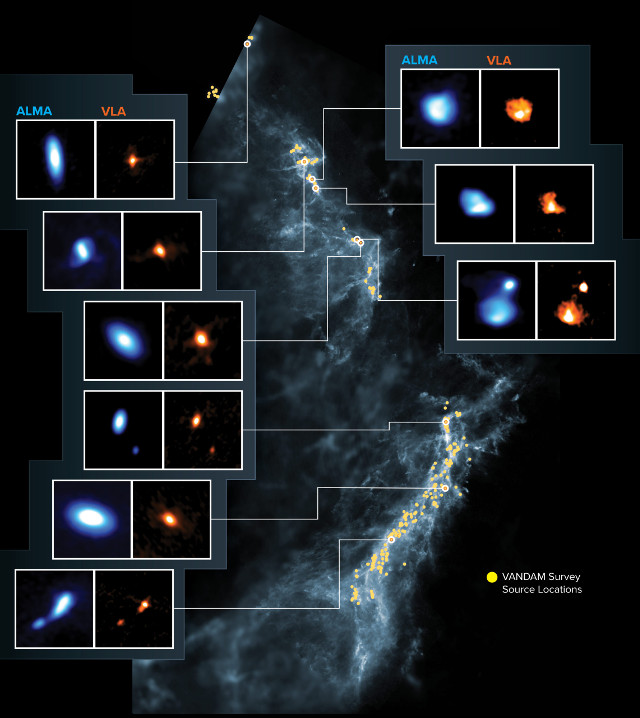
The top image (ALMA (ESO/NAOJ/NRAO), J. Tobin; NRAO/AUI/NSF, S. Dagnello; Herschel/ESA) shows the Orion Complex with the positions of the protostars studied in the VANDAM survey indicated with the yellow dots and nine protostars in the insets seen by ALMA (in blue) and VLA (in orange).
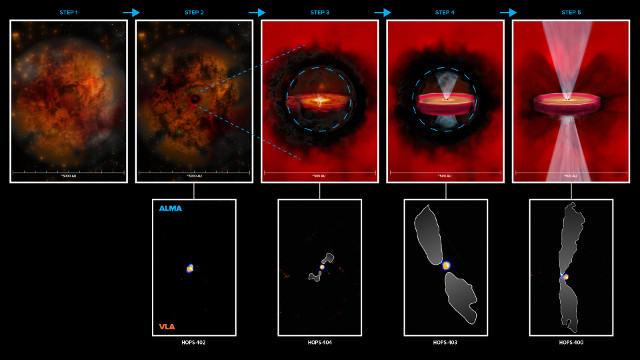
The image below (ALMA (ESO/NAOJ/NRAO), N. Karnath; NRAO/AUI/NSF, B. Saxton and S. Dagnello) shows a proposed pathway (top row) for the formation of protostars, based on four very young protostars (bottom row) observed by VLA (orange) and ALMA (blue). Step 1 represents the collapsing fragment of gas and dust. In step 2, an opaque region starts to form in the cloud. In step 3, a hydrostatic core starts to form due to an increase in pressure and temperature, surrounded by a disk-like structure and the beginning of an outflow. Step 4 depicts the formation of a class 0 protostar inside the opaque region, that may have a rotationally supported disk and more well-defined outflows. Step 5 is a typical class 0 protostar – the youngest class – with outflows that have broken through the envelope (making it optically visible), an actively accreting, rotationally supported disk. In the bottom row, white contours are the protostar outflows as seen with ALMA.
The VANDAM survey and the possible follow-up studies that can be carried out in the future on the Orion Complex’s protostars will help to understand if the proposed pathway for their formation is correct. It will also be possible to compare their protoplanetary disks with others, often older, already studied in the past also with the ALMA radio telescope.
One of the results already obtained is the discovery that very young protoplanetary disks have a size similar to the older ones but on average they’re much more massive. This makes sense thinking that over time the protostar grows by absorbing a part of those materials. The amount of materials available in the early stages of the birth of a star system suggests that at least the largest planets start forming around newborn stars.
Four of the more than three hundred protostars studied in the course of this survey were considered interesting to the point of deserving a separate article. They have a very irregular appearance, a blob of materials which suggests that they’re in one of the earliest stages of formation, perhaps even earlier than that of an actual protostar. In short, astronomers are really seeing the beginning of the story of future stars and possible star systems.