
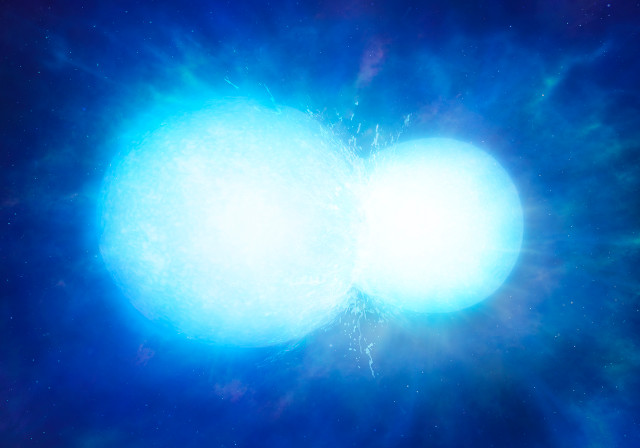
An article published in the journal “Nature Astronomy” reports a study on a white dwarf out of the ordinary cataloged as WD J055134.612+413531.09, or simply WD J0551+4135. A team of astronomers coordinated by the British University of Warwick examined this white dwarf’s characteristics using data collected by ESA’s Gaia space probe and the William Herschel Telescope concluding that its atmosphere’s particular chemical composition indicates that it’s the result the merger of two medium-mass white dwarfs. WD J0551+4135 has a mass slightly higher than that of the Sun, remarkable for that type of object to the point that it was called an ultra-massive white dwarf. If it had a slightly larger mass it would probably have exploded in a supernova following the merger.
During its red giant phase, a star loses its outer layers, which are ejected into interstellar space. The consequence is that what collapses has a mass much lower than the progenitor star’s, in fact the known white dwarfs generally have a mass around 60% of the Sun’s. Red dwarfs, which already have a mass which can be only a fraction of the Sun’s, consume their hydrogen very slowly, so the oldest stars of that category haven’t yet reached the end of their normal existence. The existing white dwarfs are the remains of stars similar to the Sun or slightly less massive.
About 150 light years from Earth, the white dwarf WD J0551+4135 was discovered by the Gaia space probe during its observations of the sky. Some white dwarfs that were particularly massive in the Data Release 2 published on April 25, 2018 became the subject of follow-up observations with the William Herschel Telescope (WHT) in the Canaries. The spectroscopic analysis possible with this instrument allowed to identify the chemical composition of the atmosphere of WD J0551+4135, which was also out of the ordinary due to the presence of high level of carbon.
Dr. Mark Hollands of the University of Warwick Department of Physics, lead author of the article, stated that the white dwarf WD J0551+4135 is something he and his colleagues had never seen before. He explained that you can expect to see an external hydrogen layer, sometimes mixed with helium, or just a mixture of helium and carbon. They didn’t expect to see a combination of hydrogen and carbon at the same time because there should be a thick layer of helium between them. When they looked at this object, it made no sense.
The survey carried out by astronomers also took into account the age of the white dwarf WD J0551+4135. The oldest white dwarfs in the Milky Way orbit faster than the younger ones and this one is faster than almost all nearby white dwarfs that appear to be the same age, which is calculated by their cooling level, which suggests that it’s older than it appears.
The astronomers put together data that seem to make no sense and concluded that the only way to explain the characteristics of the white dwarf WD J0551+4135 is that it’s the result of the merger of two medium-mass white dwarfs. This explains why it is an ultra-massive white dwarf and why its outer layer is a combination of two different possibilities. It also explains why it looks younger since the merger of two white dwarfs restarts the cooling of the resulting one.
The anomalous characteristics of the white dwarf WD J0551+4135 make it difficult to estimate its age. The merger probably occurred about 1.3 billion years ago, but the original white dwarfs may have been already billions of years old. The estimate is made difficult also by the fact that we know few white dwarfs resulting from a merger and this is the first one identified thanks to its composition. Dr. Mark Hollands explained that there are few such massive white dwarfs, but there are more than expected and this implies that some of them probably formed from mergers. He also mentioned the possibility of using the technique of asteroseismology to discover the white dwarf’s core composition from its pulsations. This would be an independent method to confirm that it’s the result of a merger.
Another reason for interest in the white dwarf WD J0551+4135 is that its mass is close to the theoretical limit beyond which the merger would have led it to explode in a supernova. In fact, its mass is about 1.14 times the Sun’s while the calculated limit is 1.4 times the Sun’s mass. Finding ultra-massive white dwarfs helps to verify that that limit was calculated correctly. Consequently, these are studies that help to better understand white dwarfs and therefore what will happen to the Sun in a few billion years.
