
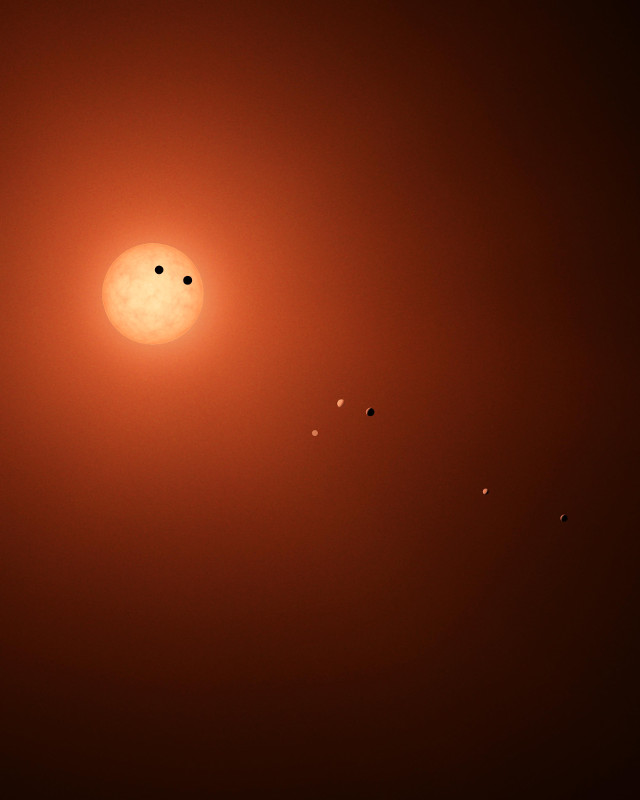
An article published in “The Astrophysical Journal” reports a study on the X-ray and ultraviolet (XUV) luminosity of TRAPPIST-1, the ultra-cool dwarf star that became famous after the confirmation that it has a system of 7 rocky planets. A team of researchers used a Markov Chain Monte Carlo method to calculate the radiation received over time by those planets concluding that the star had high levels of X-ray and ultraviolet emissions for several billion years causing its planets significant atmospheric erosion and loss of volatile compounds. The researchers also showed that the free / open source approxposterior software can replicate their analysis much faster than emcee, a software used for that type of calculation. This will help to study other red dwarfs to evaluate the habitability of the planets that are increasingly found orbiting red dwarfs.
The confirmation of the 7 rocky planets in the TRAPPIST-1 system on February 22, 2017 was an important moment for astronomy because it was the first system in which a number of planets close to those of the solar system was found, and in that case they’re all with sizes and masses close to the Earth’s. The fact that the star is really tiny, with a mass slightly above the minimum required to sustain nuclear fusion, was also important because it showed that even very small stars can have interesting planetary systems.
One of the main problems indicated from the beginning was the one about the emissions of very energetic electromagnetic radiation by the star TRAPPIST-1. Red dwarfs and ultra-cool dwarfs are small but they can have powerful flares with strong emissions of ultraviolet rays and even X-rays. The planets of TRAPPIST-1 are all very close to their star, so the effects of those emissions can be very heavy causing the erosion of possible atmospheres and the dispersion of volatile compounds into space. One hope came from the fact that TRAPPIST-1 is probably much older than the Sun and the consequences of its most intense activity may have long since passed. However, it was necessary to calculate how many electromagnetic radiation of those types were emitted by the star.
The authors of this research used an algorithm part of the Markov Chain Monte Carlo methods to calculate probabilities. The free / open source emcee software, written in the Python language, is among those used for this type of calculation and was applied to the evolution of TRAPPIST-1’s X-ray and ultraviolet emissions. Another software called approxposterior, also written in Python and released under a free / open source license, was used to compare the results and took significantly less time and significantly less simulations to get those results. That’s because it’s a machine learning algorithm that can be much more efficient after the initial training period.
The end result remains negative for the TRAPPIST-1 system because it indicates that the star emitted significant amounts of X-rays and ultraviolet rays for several billion years. In the first phase of their life, its internal planets received these emissions at levels thousands of times higher than what the Earth received from the Sun. Such emissions can wipe out a planet’s atmosphere and its volatile compounds with heavy consequences on its habitability.
This type of research is based on mathematical models that implement known information about a star, which in this case is TRAPPIST-1 but could be another red or ultra-cool dwarf. The information available on the planets indicates that some of them have a low density that suggests a significant presence of water and perhaps frozen volatile compounds that can replace the lost ones. Discussions about the possibility that at least some planets in the TRAPPIST-1 system are habitable are likely to continue for many years. They’re very useful to understand the conditions needed for an exoplanet to have the potential to host life forms similar to the Earth’s.

Permalink