
An article published in “The Astrophysical Journal” reports a study on a possible quick growth mechanism of supermassive black holes that could explain their presence when the universe was very young. Ph.D. student at SISSA (International School of Advanced Studies) Lumen Boco and his supervisor Andrea Lapi created a new model based on a process already considered important called dynamical friction in the gaseous medium applying it to multiple mergers.
Quasars already existed when the universe was less than a billion years old and their very strong electromagnetic emissions are so strong that they’re visible from Earth even from distances of about 13 billion light years. Quasars are powered by supermassive black holes and that means that black holes existed with masses that were millions of times the Sun’s when the universe was still very young in astronomical terms. The mechanisms that allowed these masses to be concentrated relatively quickly, also considering that the formation of the first galaxies took a few hundred million years, are still under discussion. A model is now being proposed to explain why the early stages of a supermassive black hole’s development might be faster than previously thought.
Black holes of stellar origin are born from the cores left after supernovae have ended the normal life of stars. In young galaxies they could be produced in large quantities and quickly because there were many massive stars that consumed their hydrogen in just a few million years. These black holes, with masses a few dozen times that of the Sun, were immersed in clouds of gas which exerted a dynamic friction on them which could lead them to migrate towards the center of the galaxy. In that region, black holes could merge to form what is called the seed of a supermassive black hole. This mechanism is considered slow and the supermassive black holes observed in the early universe could not exist only thanks to it. This new research offers a solution that explains why that process is much faster.
According to the researchers, a seed with a mass between 10,000 and 100,000 times the Sun’s takes between 50 and 100 million years to form. At that point, the seed attracts the surrounding gas in huge amounts because according to the model created in this research, the seed’s mass makes its growth very quick, to the point of reaching the levels observed in the primordial quasars.
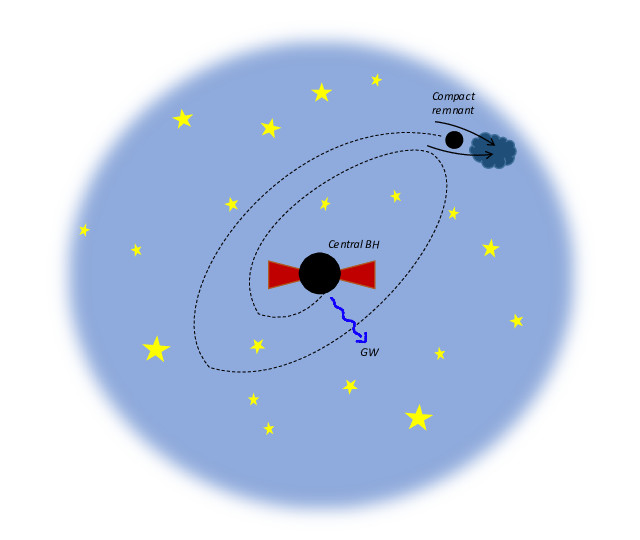
The image (Courtesy L. Boco et al. All rights reserved) illustrates the seed formation mechanism. A black hole is referred to as “Compat remnant”, attracted to the center of the galaxy that hosts it where there’s a black hole (Central BH) it merges with emitting gravitational waves (GW).
The monitoring of sources of gravitational wave emissions by the LIGO/Virgo collaboration is continuously improving and in the future new generation detectors will be able to further improve investigations. This could allow to verify the model proposed in this research, which for now is based on mathematical calculations. Once again, the future of black hole research could be linked to gravitational waves, a booming branch of astronomy.
