
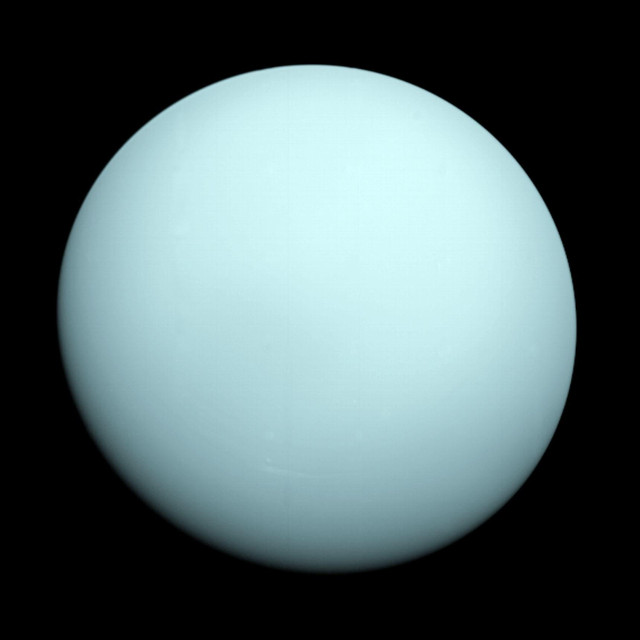
An article published in the journal “Geophysical Research Letters” reports the discovery of a plasmoid, a structure composed of plasma formed mainly of hydrogen in the midst of magnetic fields, in the magnetotail – the magnetosphere’s tail – of the planet Uranus that was moving away from it. The plasmoid’s formation isn’t a new event because Gina DiBraccio and Daniel J. Gershman of NASA’s Goddard Space Flight Center examined the observations made by the Voyager 2 space probe during the its Uranus flyby on January 24, 1986. It’s the first plasmoid discovered in the Uranus’ atmosphere and could be a crucial mechanism for its loss of atmosphere.
Uranus is a planet that historically has been considered anomalous by astronomers, for a long time because its rotation axis is inclined by almost 98° with the consequence that it substantially spins on its side, so its days and seasons are different compared to other planets. During the period of the solstices, one pole is constantly facing the Sun while the other is constantly in the dark. In the period of the equinoxes, the equator is facing the Sun and is the only one in which there’s a day-night alternation similar to that of the other planets, even if the Sun rises in the west and sets in the east. Thanks to the Voyager 2 space probe, astronomers discovered that Uranus’ magnetic field is inclined by 59° with respect to its rotation axis and is out of phase with respect to the planet’s center, with the consequence that it’s asymmetrical.
The unique characteristics of the magnetosphere created by the planet Uranus’ magnetic field also kept the interest in the data collected by the Voyager 2 space probe over the years. Space physicists Gina DiBraccio and Daniel J. Gershman also looked at those data while they were part of a team that was working on plans for a possible new mission to study the so-called frozen giants Uranus and Neptune. While looking for something interesting about Uranus, they noticed that during its January 24, 1986 flyby, Voyager 2 detected the presence of a plasmoid in the magnetotail.
A plasmoid is a structure composed of plasma, meaning ionized gas which in this case is mainly hydrogen, with a shape created by an external magnetic field. Plasmoids have been identified in the magnetospheres of other planets including Jupiter and Saturn but also Mercury. On Earth, plasmoids can form in the magnetotail due to magnetic reconnection. It’s the first time that they were discovered in the frozen giants.
Plasmoid formation in Uranus’ magnetosphere can make an important contribution to its loss of atmosphere. Gina DiBraccio and Daniel J. Gershman’s estimates can only be vague, indicating a percentage between 15% and 55% of the planet’s loss of atmosphere. A lot depends on how common plasmoids are, but having only one observation available, researchers had to make various assumptions, obtaining approximate estimates.
Having complete data on the processes of formation of plasmoids on Uranus and finding out if they also form in the magnetosphere of Neptune would provide more useful information to improve models applicable to other planets as well. In Uranus’ case, a new mission would help to better understand its strange characteristics, which could be due to the crash of another large celestial body.
