March 2020

Artist's concept of iron rain on the exoplanet WASP-76b (Image ESO/M. Kornmesser)

An article published in the journal “Nature” reports a study on the conditions existing on the exoplanet WASP-76b, an ultra-hot Jupiter where on the side illuminated by its star it’s so hot that metals vaporize and then condense on the dark side, where it rains iron. A team of researchers led by David Ehrenreich of the University of Geneva, Switzerland, used the ESPRESSO instrument mounted on the VLT in Chile to study the processes underway in the atmosphere of WASP-76b with the winds that carry the iron vapor across this gas giant.

Thiophene structure

An article published in the journal “Astrobiology” reports a study on the possible origin of organic compounds known as thiophenes discovered on Mars by NASA’s Mars Rover Curiosity. Jacob Heinz of the Technische Universität in Berlin and Dirk Schulze-Makuch of Washington State University described some possible processes leading to the formation of thiophenes. These possible processes can be non-biological or biological, and the problem is to find evidence that points to one of them. Thiophenes also exist on Earth and there’s a tendency to think that they’re formed as a result of biological processes, but on Mars this would mean that life forms exist.

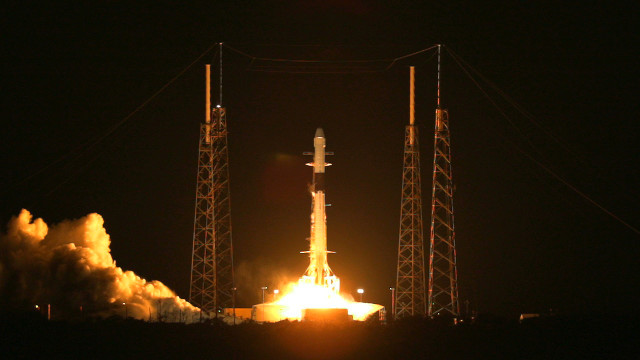
The Dragon cargo spacecraft blasting off for its CRS-20 mission atop a Falcon 9 rocket (Photo NASA)

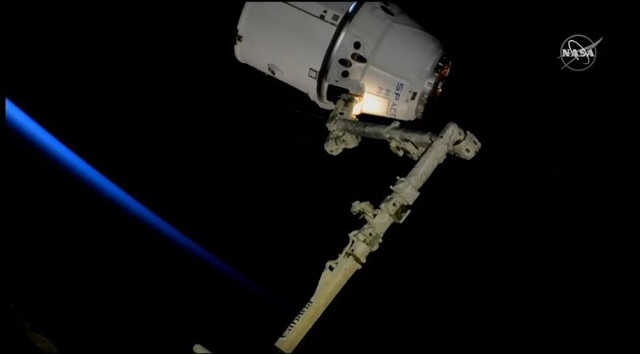
A few hours ago the SpaceX Dragon spacecraft blasted off atop a Falcon 9 rocket from Cape Canaveral in its CRS-20 (Cargo Resupply Service 20) mission, also referred to as SPX-20. After just over ten minutes it separated successfully from the rocket’s last stage and went en route. This is the 20th mission for the Dragon spacecraft to resupply the International Space Station with various cargoes and then return to Earth, again with various cargoes. It’s the last mission for this Dragon version, which will be replaced by Dragon 2 from the next mission.

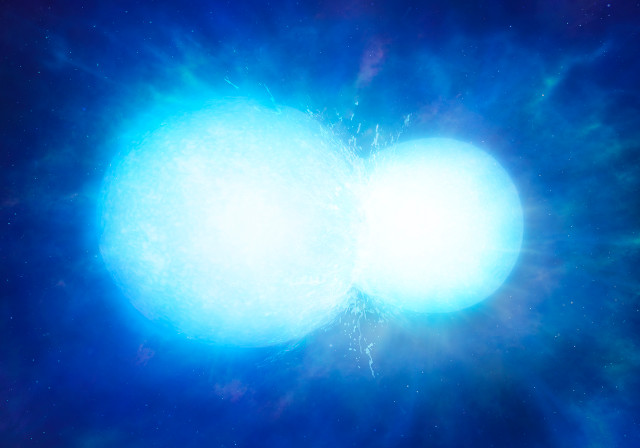
Artist's concept of colliding white dwarfs (Image courtesy University of Warwick/Mark Garlick)

An article published in the journal “Nature Astronomy” reports a study on a white dwarf out of the ordinary cataloged as WD J055134.612+413531.09, or simply WD J0551+4135. A team of astronomers coordinated by the British University of Warwick examined this white dwarf’s characteristics using data collected by ESA’s Gaia space probe and the William Herschel Telescope concluding that its atmosphere’s particular chemical composition indicates that it’s the result the merger of two medium-mass white dwarfs. WD J0551+4135 has a mass slightly higher than that of the Sun, remarkable for that type of object to the point that it was called an ultra-massive white dwarf. If it had a slightly larger mass it would probably have exploded in a supernova following the merger.