
March 2020

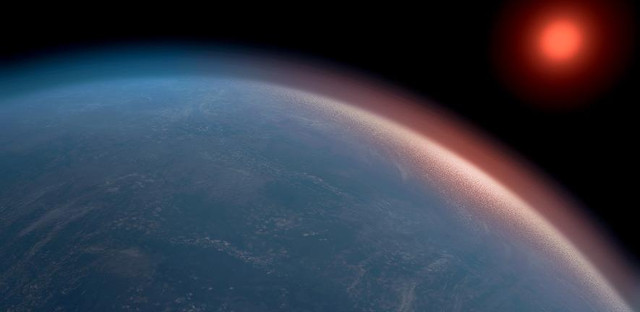
Artist's impression of K2-18b (Image courtesy Amanda Smith)

An article published in “The Astrophysical Journal Letters” reports a study on the potential habitability conditions of the exoplanet K2-18b. A team from the British University of Cambridge led by Nikku Madhusudhan conducted a series of simulations based on the possible values of mass, size, and atmosphere data value available on it to create various models compatible with the observations. According to the conclusions, under certain conditions there may be liquid water on its surface.

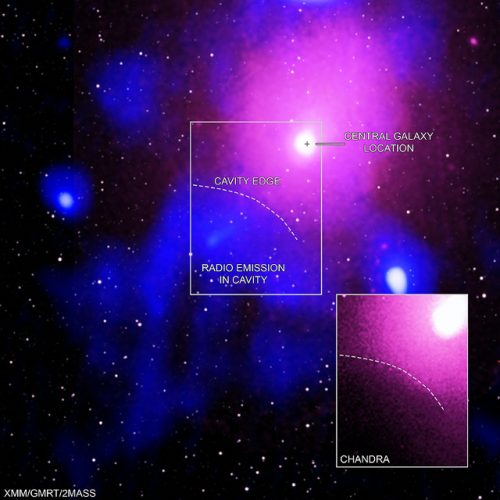
The outburst region in the Ophiuchus supercluster

An article published in “The Astrophysical Journal” reports the observation of what was called the largest explosion discovered in the universe after the Big Bang and caused by the supermassive black hole in the galaxy at the center of the Ophiuchus supercluster. A team of astronomers led by Simona Giacintucci of the Naval Research Laboratory combined X-ray observations with ESA’s XMM-Newton and NASA’s Chandra space telescopes with those at radio frequencies conducted with Murchison Widefield Array (MWA) and Giant Metrewave Radio Telescope (GMRT) radio telescopes to map the cavity generated by that cataclysmic event, about 15 times the Milky Way’s size.