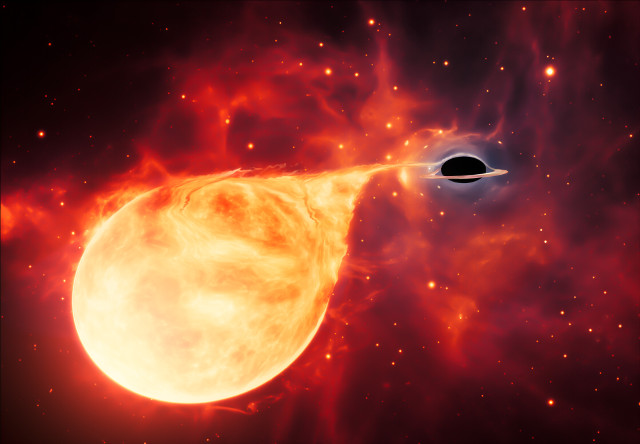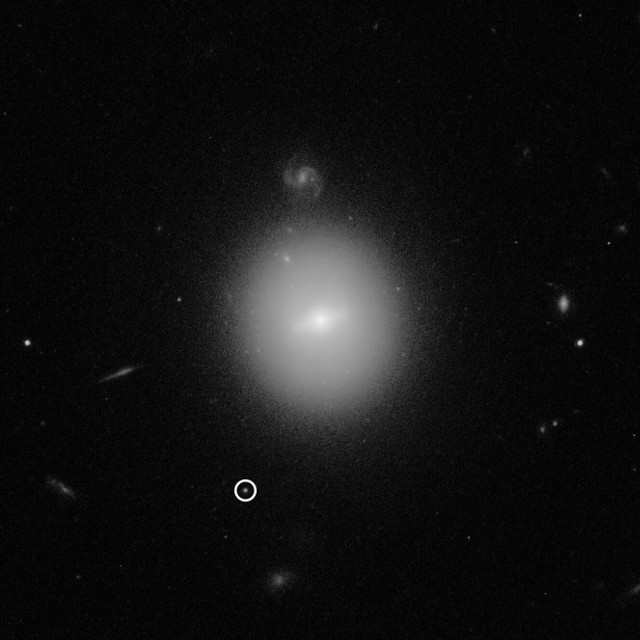
An article published in “The Astrophysical Journal Letters” reports the discovery of the best evidence so far of the existence of intermediate-mass black holes. A team of researchers led by Dacheng Lin of the University of New Hampshire used the Hubble Space Telescope for a follow-up study based on X-ray data collected by other space telescopes that observed the source cataloged as 3XMM J215022.4-055108. The result is that this source is located in a dense star cluster on the periphery of another galaxy and the characteristics indicate that it’s an intermediate-mass black hole with a mass over 50,000 times the Sun’s.
In 2006, NASA’s Chandra X-ray Observatory and ESA’s XMM-Newton space telescope, two telescopes specializing in X-ray astronomy, detected a powerful X-ray flare. At the time, it wasn’t possible to detect the position of the source, cataloged as 3XMM J215022.4-055108, but the observations continued. The Hubble Space Telescope provided indications that the source was in another galaxy, in a dense star cluster on its periphery.
The general rule of thumb from previous research is that the mass of a supermassive black hole at the center of a galaxy is proportional to the overall mass of the galaxy. Actually, exceptions to this rule have been found but it’s possible that an intermediate-mass black hole such as 3XMM J215022.4-055108 was at the center of a dwarf galaxy absorbed by a much larger galaxy. The fact that the black hole is now in a star cluster suggests that origin.
3XMM J215022.4-055108 isn’t the first intermediate-mass black hole candidate, but it’s difficult to find them because they’re much smaller and less active than supermassive black holes. Basically, astronomers can find them in situations such as the destruction of a star, which generates X-ray emissions like the one discovered in 2006 in this source. That emission allowed astronomers to estimate the black hole’s mass in over 50,000 times the Sun’s.
Follow-up studies of 3XMM J215022.4-055108 can be conducted to confirm that it’s an intermediate-mass black hole. Dacheng Lin’s team intends to continue searching for this type of object by taking advantage of the X-ray emissions that occur when they devour a star that gets too close. Finding more candidates would help to identify them with certainty and to create models regarding their origin and evolution. There are still many questions about these objects, starting with the possible relationship with supermassive black holes.