An article published in the journal “Nature Astronomy” reports a study on the interstellar comet 2I/Borisov focused in particular on its chemical composition which highlights the abundance of carbon monoxide and hydrogen cyanide. A team of researchers led by Martin Cordiner and Stefanie Milam of NASA’s Goddard Space Flight Center used the ALMA radio telescope to examine the comet’s emissions detecting that carbon monoxide is present in its coma in an amount that is between 9 and 26 times that estimated for the solar system’s comets. This suggests that it formed in a very cold area of its origin system.
Comet 2I/Borisov, initially designated as C/2019 Q4, was discovered on August 30, 2019, by the amateur astronomer Gennady Borisov and after some observations the data about its orbit started suggesting its interstellar origin. confirmed by follow-up observations.
Many observations of the interstellar comet 2I/Borisov were carried out with the Hubble space telescope, which already provided an idea of the composition of its gas emissions thanks to its Cosmic Origins Spectrograph’s ultraviolet sensitivity. Some observations carried out between December 2019 and January 2020 indicated the presence of carbon monoxide, oxygen, and water that sublimated thanks to the relative proximity to the Sun.
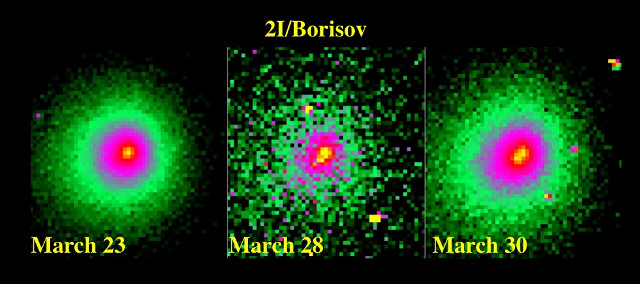
In early April, news came that Hubble observed the detachment of a fragment of the 2I/Borisov nucleus which was destroyed in a few days following the increase in sublimation activity to the point of becoming an outburst. The bottom image (Hubble Space Telescope) shows the 2I/Borisov nucleus as it stretches in late March. This suggests that the fragment came off in those days.
During December 2019, the observations of the interstellar comet 2I/Borisov were integrated with others carried out using NASA’s Swift space telescope and especially the ALMA (Atacama Large Millimeter/submillimeter Array) radio telescope, inaugurated in March 2013. Generally it’s used to study objects millions or even billions of light-years away, but in this case its sensitivity made it possible to study gas emissions from a relatively close object within the solar system.
The presence of hydrogen cyanide in the interstellar comet 2I/Borisov was expected and was found in amounts similar to those of the solar system’s native comets. Instead, carbon monoxide was present in an amount between 9 and 26 times that estimated for the solar system’s comets, higher than that detected in any comet that arrived at a distance from the Sun less than twice that of the Earth from the Sun. The top image (ALMA (ESO/NAOJ/NRAO), M. Cordiner & S. Milam; NRAO/AUI/NSF, S. Dagnello) shows 2I/Borisov observed by ALMA: on the left the hydrogen cyanide component is highlighted while on the right the carbon monoxide component is highlighted.
According to the researchers, the significant amount of carbon monoxide present in the interstellar comet 2I/Borisov could be explained by its formation in a very cold region of its origin system. That’s because carbon monoxide ice forms at temperatures below -250° Celsius, typical of regions such as the Kuiper Belt.
It’s difficult to have precise information without knowing where the interstellar comet 2I/Borisov came from. Its composition might be common, but without having others to examine it may seem anomalous. Powerful and sensitive instruments together with the experience that astronomers are slowly accumulating will help to better understand other star systems.