April 2020

IS-901 seen by MEV-1

Intelsat and Northrop Grumman have announced that the communications satellite Intelsat 901 (IS-901) has returned to active service after the Mission Extension Vehicle 1 (MEV-1) spacecraft docked on February 25, 2020. MEV-1 will allow Intelsat 901 to maintain its orbit and attitude again for almost 5 years, extending its life. It’s the first time that a satellite has returned to activity thanks to this type of mission.

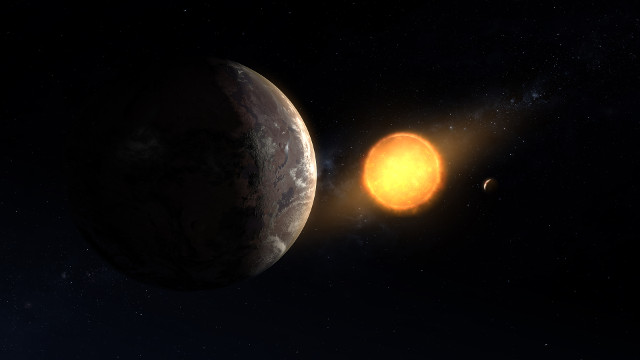
Artist's concept of the exoplanet Kepler-1649c and its star (Image NASA/Ames Research Center/Daniel Rutter)

An article published in “The Astrophysical Journal Letters” reports the discovery of the exoplanet Kepler-1649c, which has a size very similar to the Earth’s and orbits in ​​its system’s habitable zone. A team of researchers led by Andrew Vanderburg of the University of Texas, Austin, reanalyzed data collected by NASA’s Kepler space telescope and subsequently analyzed using software written for that task. Initially, only one exoplanet was confirmed in that system while another candidate was discarded. A human verification led to the confirmation of the planet that was cataloged as Kepler-1649c. The two planets’ orbital characteristics suggest the possibility that a third one exists, even if for now the researchers haven’t been able to find any traces of it.

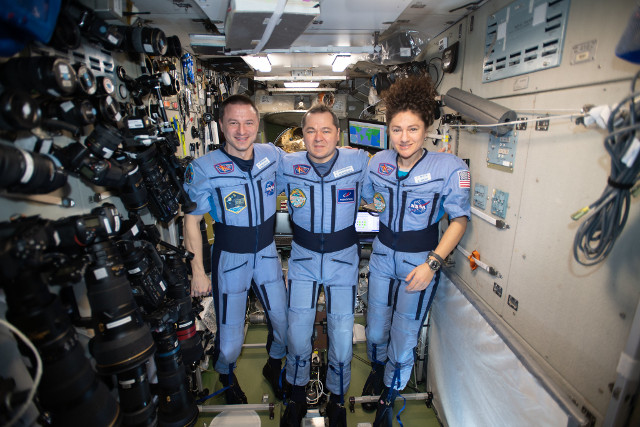
Andrew Morgan, Oleg Skripochka and Jessica Meir (Photo NASA)

A little while ago astronauts Jessica Meir and Andrew Morgan and cosmonaut Oleg Skripochka returned to Earth on the Soyuz MS-15 spacecraft, that landed in Kazakhstan. The three of them spent a bit more than 6 months on the International Space Station, where they arrived on September 25, 2019 as part of Expedition 61. After landing, they were assisted by a skeleton crew with the precautions needed to avoid the risk of Covid-19 infection.

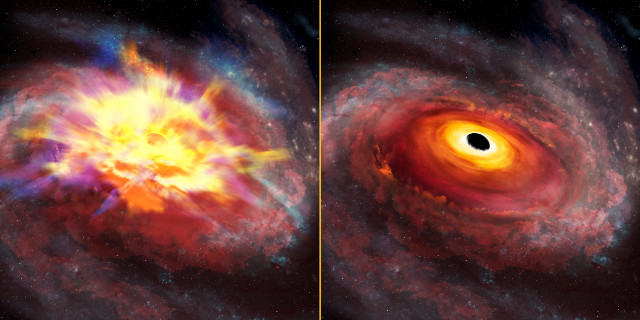
Artistic concept of the quasar SDSS J135246.37+423923.5 and the galaxy that hosts it

An article published in “The Astrophysical Journal” reports the discovery of the most energetic outflow from a distant quasar, to be precise from the one classified as SDSS J135246.37+423923.5. A team of researchers used the Gemini North telescope, Hawaii, to conduct the observations they needed and a new computer modeling system had to be used to interpret what was called an extragalactic storm hidden in plain sight for 15 years. The outflow, a sort of cosmic wind, travels at a speed that is almost 13% of the speed of light with a strong impact on the star formation in the galaxy hosting the quasar.

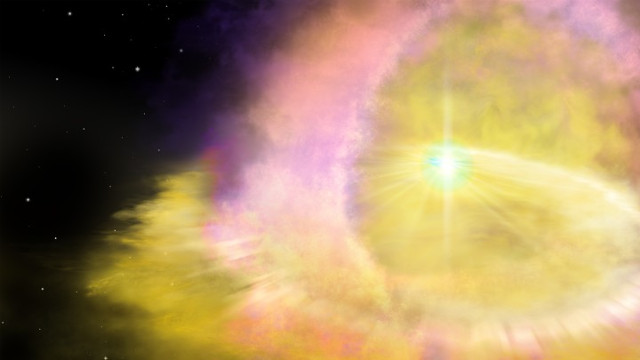
Artist's impression of a supernova (Image Aaron Geller (Northwestern University))

An article published in the journal “Nature Astronomy” reports a study on the supernova cataloged as SN2016aps, which was found to be at least twice as bright and probably much more massive than any other registered supernova. A team of astronomers led by Dr. Matt Nicholl of the British University of Birmingham observed the evolution of the supernova for about two years until it faded to 1% of its peak brightness. The conclusion is that the initial mass of the exploded star might have been even more than 100 times the Sun’s and this suggests that it was a very rare type called a pulsational pair-instability supernova.