April 2020

The star LHS 1815

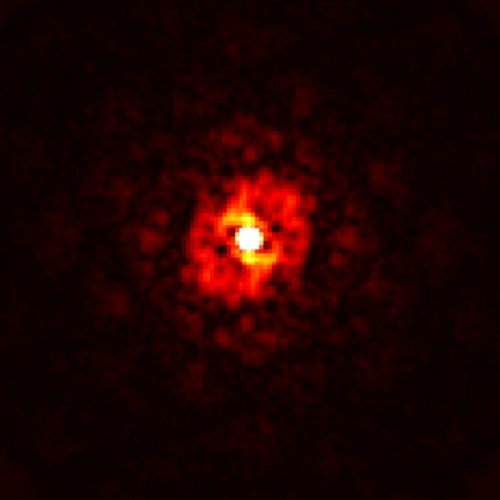
An article published in “The Astronomical Journal” reports the discovery of the exoplanet LHS 1815b thanks to NASA’s TESS space telescope. A team of researchers led by Tianjun Gan of Tsinghua University in Beijing, China, confirmed the existence of that planet using various ground-based photometric, spectroscopic and photographic instruments. The conclusion is that its size is slightly higher than the Earth’s, but it’s much denser for a mass up to 8.7 times the Earth’s. The most unique feature is that it’s the first exoplanet discovered in the Milky Way’s so-called thick disk, one of the structures that make up about two thirds of disk galaxies.

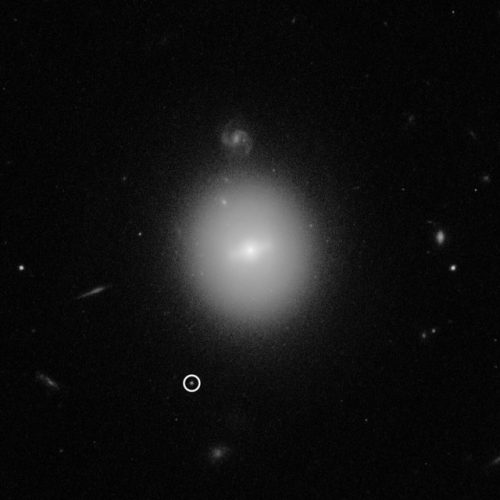
3XMM J215022.4-055108 in the circle (Image NASA, ESA, and D. Lin (University of New Hampshire))

An article published in “The Astrophysical Journal Letters” reports the discovery of the best evidence so far of the existence of intermediate-mass black holes. A team of researchers led by Dacheng Lin of the University of New Hampshire used the Hubble Space Telescope for a follow-up study based on X-ray data collected by other space telescopes that observed the source cataloged as 3XMM J215022.4-055108. The result is that this source is located in a dense star cluster on the periphery of another galaxy and the characteristics indicate that it’s an intermediate-mass black hole with a mass over 50,000 times the Sun’s.

The quasar MG J0414+0534

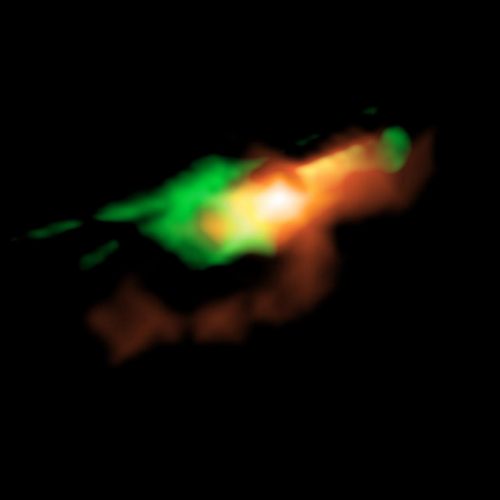
An article published in “The Astrophysical Journal Letters” reports the observation of jets of energetic particles coming from a supermassive black hole interacting with clouds of gas around them in the quasar MG J0414+0534, about 11 billion light years away. A team of researchers used the ALMA radio telescope to observe that quasar, but its details were detected thanks to a gravitational lensing effect generated by a galaxy between the quasar and the Earth. The interaction between jets and clouds suggests that the quasar’s radio activity is at an early stage and therefore useful to better understand the early stages of evolution of the galaxies that host a quasar in the early universe.