An article published in “The Astrophysical Journal Supplement Series” reports the results of a series of combined observations of the planet Jupiter. A team of researchers led by Michael Wong of the University of California, Berkeley, used data collected by the Hubble Space Telescope, the Gemini Observatory in Hawaii and NASA’s Juno space probe to obtain a broader picture of various phenomena taking place in Jupiter’s atmosphere. Storms include the Great Red Spot, which the combined observations help us understand better.
Jupiter’s gigantic storms have been studied since before their nature was known, starting with the Great Red Spot. When instruments capable of probing below the surface of the planet were built, it was possible to start understanding their size, with depths that can reach more than 60 kilometers. Jupiter’s atmosphere is very different from the Earth’s, but also on the gas giant there are lightnings that generate electromagnetic emissions. The combination of data collected by different instruments sensitive to different wavelengths can provide a more complete picture of those phenomena, the composition of the atmosphere and other characteristics of the planet.
The top image (NASA, ESA, M.H. Wong (UC Berkeley), A. James and M.W. Carruthers (STScI), and S. Brown (JPL)) reports a graphic that shows observations and interpretations of cloud structures and atmospheric circulation on Jupiter from the Juno spacecraft, the Hubble Space Telescope and the Gemini Observatory. By combining the Juno, Hubble and Gemini data, researchers are able to see that lightning flashes are clustered in turbulent regions where there are deep water clouds and where moist air is rising to form tall convective towers similar to cumulonimbus clouds (thunderheads) on Earth. The bottom illustration of lightning, convective towers, deep water clouds and clearings in Jupiter’s atmosphere is based on data from Juno, Hubble and Gemini, and corresponds to the transect (angled white line) indicated on the Hubble and Gemini map details. The combination of observations can be used to map the cloud structure in three dimensions and infer details of atmospheric circulation. Thick, towering clouds form where moist air is rising (upwelling and active convection). Clearings form where drier air sinks (downwelling). The clouds shown rise five times higher than similar convective towers in the relatively shallow atmosphere of Earth. The region illustrated covers a horizontal span one-third greater than that of the continental United States.
By mapping the lightnings detected by the Juno space probe on optical images captured by Hubble and infrared thermal images captured at the same time by Gemini, the researchers were able to show that the lightnings are associated with a three-way combination of cloud structures. Deep clouds made of water, large convective towers caused by rising damp air, in practice storm clouds, and clear regions generated by the descent of drier air out of the convective towers.
Hubble data show the height of the thick clouds in the convection towers and the depth of the deep water clouds. Gemini’s data clearly reveals the clearings in the high-level clouds where deep-water clouds can be glimpsed. The possibility of correlating lightning and deep water clouds gives researchers another tool to estimate the amount of water in Jupiter’s atmosphere, important to understand how Jupiter and the other gas giants were formed, a crucial event in the formation of the entire solar system.
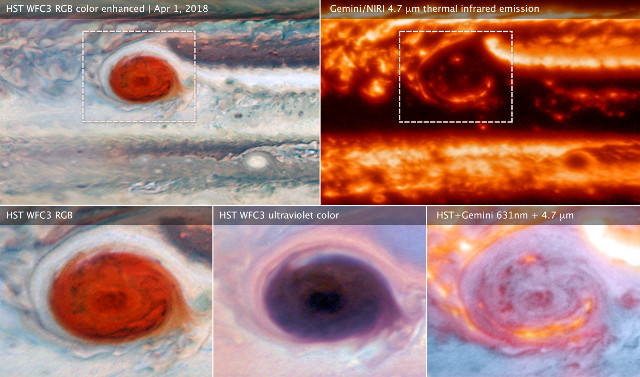
The Great Red Spot is always at the center of interest in Jupiter’s studies and the Juno mission allows scientists to study its short-term changes. Frequent observations are necessary to understand the phenomena in progress and find explanations for mysteries such as that of dark objects in the Spot that appear, disappear and change shape over time. The images obtained at different wavelengths provided a more complete picture, in this case because they’re regions that are dark in visible light, but very bright at infrareds. This indicates that these are holes in the layer of clouds, which block infrareds.
The bottom image (NASA, ESA, and MH Wong (UC Berkeley) and team) shows various images of the Great Red Spot: on the left side (detail in the lower one) seen by Hubble, upper right seen by Gemini at infrareds, lower middle seen by Hubble at ultraviolets, and lower right a composite of Hubble and Gemini’s images.
The images of Jupiter captured by Hubble and Gemini in support of the Juno mission are providing important information in the study of the planet’s atmospheric phenomena. Tracing the presence of water also helps to better understand the composition of the Jovian atmosphere, a step forward in the study of the planet’s formation and evolution. Some answers can also be applied to other gas giants and this offers new clues to the processes that led to the formation of the solar system.