
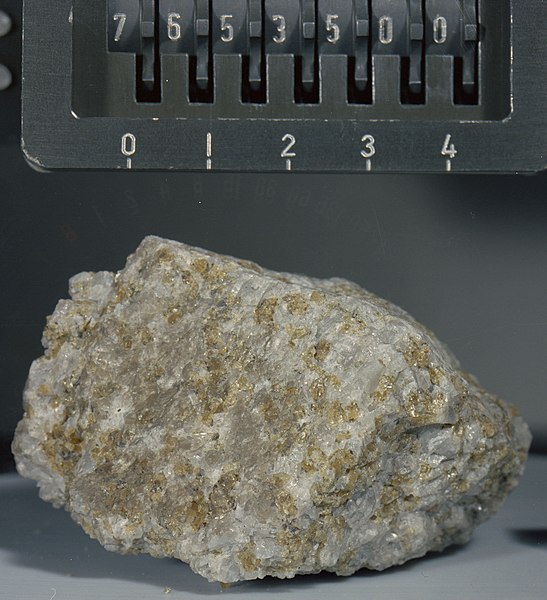
An article published in the journal “Nature Astronomy” reports evidence of significant impacts on the primordial Moon, at least 4.33 billion years ago. A team of researchers carried out a study in particular on the sample cataloged as Troctolite 76535, taken during the Apollo 17 mission in 1972 and brought back to Earth. This specimen contains traces of cubic zirconia, a crystalline form of zirconium oxide that forms above 2370° Celsius, a temperature that could only be reached following violent impacts that could have contributed to the formation of the Moon’s surface.
The Moon’s history is interesting also because it’s closely linked to that of the Earth, but its reconstruction is complex because it’s based in many cases on space probes’ detections and computer simulations. This makes the samples taken during the Apollo missions valuable because even the analysis of a few rock fragments can offer some direct answers to geologists.
The sample Troctolite 76535 (NASA/Johnson Space Center photograph S73-19456) was collected in 1972 during the Apollo 17 mission, the last on the Moon. Astronaut Harrison Schmitt collected it in the Moon area called Taurus–Littrow valley.
Like the other samples taken during the Apollo missions, Troctolite 76535 has been the subject of many studies over the decades and this one was focused on the traces of cubic zirconia, a crystalline form of zirconium oxide that forms above 2370° Celsius. Over time, the crystal turned into baddeleyite, a more stable structure, and was dated at around 4.3 billion years ago. This means that it formed when the Moon was young, and that violent impacts occurred on the Moon’s surface that released enough energy to generate cubic zirconia.
On Earth, rocks mix continuously thanks to plate tectonics and volcanism, on the Moon instead rocks dating back to the period immediately following its formation are preserved because there are no such activities. However, traces indicate that the Moon’s outer and inner layers mixed up. Impacts that can generate cubic zirconia are an explanation.
Dr. Ana Cernok of the Royal Ontario Museum, among the authors of this study, stated that the small baddeleyite grain found in the sample Troctolite 76535 offers evidence of the formation of an impact basin of hundreds of kilometers in diameter. On Earth there’s no evidence of such ancient impacts, but on the Moon such evidence is still preserved.
This study is also important because its conclusions derive from analysis of a Moon rock fragment, not from computer simulations. The new plans for Moon missions could enable to take more samples with other traces of impacts and offer more answers on the Moon’s history.
