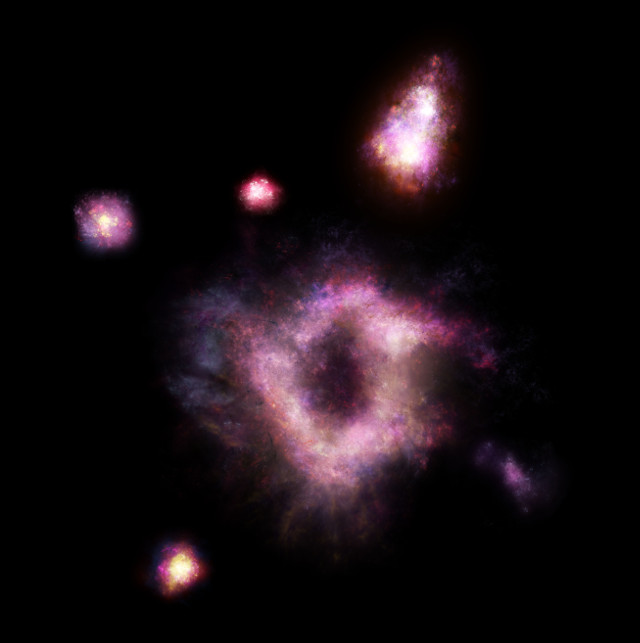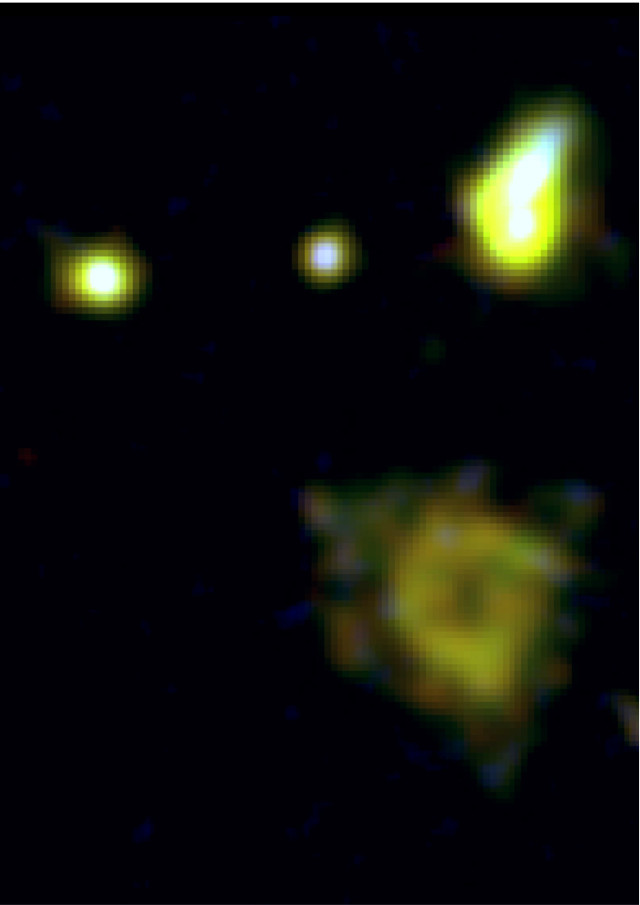
An article published in the journal “Nature Astronomy” reports the study of a very rare type of galaxy, called a cosmic ring of fire. A team of researchers led by Dr. Tiantian Yuan from Australia’s ARC Centre of Excellence for All Sky Astrophysics in 3 Dimensions (ASTRO 3D) used spectroscopic images obtained at the Keck Observatory in Hawaii and images captured by the Hubble Space Telescope to identify the strange structure of the galaxy officially designated as R5519. It’s an ancient galaxy, and its discovery may require new changes to current galactic formation models.
About 11 billion light-years away from Earth, the galaxy R5519 has a mass similar to the Milky Way’s, but it’s ring-shaped, with a hole in the middle. Ring galaxies have long been known, and the observations of R5519 indicate that it’s a collisional ring galaxy, which means that its shape is due to a collision with at least one other galaxy.
The activity of the galaxy R5519 is interesting because Dr. Tiantian Yuan explained that it’s making stars at a rate 50 times greater than the Milky Way. Most of that activity is taking place in its ring, and for this reason it was called a cosmic ring of fire.
It’s the first time that a collisional ring galaxy has been discovered in the primordial universe, and this led the researchers to ask some questions about its formation. Professor Kenneth Freeman of Australian National University, another of the authors of this research, explained that collisional formation of ring galaxies requires a thin disk to be present in the “victim” galaxy before the collision occurs. The thin disk is a component that defines spiral galaxies but, according to current models, 11 billion years ago such disks were still assembling. The Milky Way’s disk started assembling about 9 billion years ago. The discovery of the galaxy R5519 indicates that the assembly of disks in spiral galaxies took place over a longer period than previously thought.
Collisional ring galaxies are very rare in the local universe, and the fact that R5519 is the first discovered at a distance of about 11 billion light-years suggests that they have always been rare. This discovery is the result of luck and hard work to analyze data from different instruments that made it possible to identify it. The study of these data will help to better understand the evolution of galaxies such as the Milky Way as well.