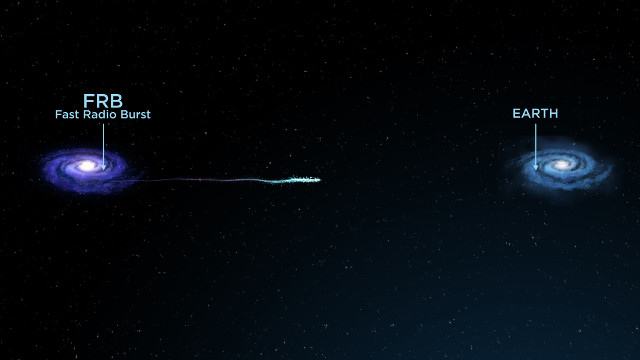
An article published in the journal “Nature” reports a measurement of the amount of the so-called baryonic matter, ordinary matter, in the universe analyzing the characteristics of fast radio bursts (FRBs). A team of researchers led by Professor Jean-Pierre Macquart from the Curtin University node of the International Centre for Radio Astronomy Research (ICRAR), used detections carried out using the ASKAP radio telescope, which allowed to determine the position of the FRBs in the galaxies that host them with considerable precision. By analyzing their characteristics it was possible to determine the density of matter between their point of origin and the Earth.
Measurements of the amount of baryonic matter existing in the universe showed that estimates such as those obtained with the map created thanks to ESA’s Planck Surveyor satellite indicate an amount approximately five times greater than the estimate obtained by adding the baryonic matter that forms galaxies, including halos that surround them, and even the gas that fills galaxy clusters. For over twenty years scientists have been looking for ways to find the missing baryonic matter, but there are places like intergalactic space where it has a very low density.
One method of detecting intergalactic baryonic matter using quasars was described in an article published in the journal “Nature” in June 2018 in a type of research that is continuing. Now Jean-Pierre Macquart’s team proposed a different method that uses fast radio bursts, a phenomenon still mysterious because such powerful radio emissions require an estimated energy that is approximately that emitted by the Sun in 80 years despite their duration of a few milliseconds.
Professor Ryan Shannon from Swinburne University of Technology, another of the authors of this research, explained the importance of the ASKAP (Australia Square Kilometer Array Pathfinder) radio telescope of Commonwealth Scientific and Industrial Research Organization (CSIRO), one of the precursors to the SKA, the next-generation radio telescope, in which it will be integrated in a few years. ASKAP has a large field of view, approximately 60 times the size of the full Moon, and allows to obtain high-resolution images. This means that researchers can catch fast radio bursts relatively easily and pinpoint their location in the galaxies that host them with incredible precision.
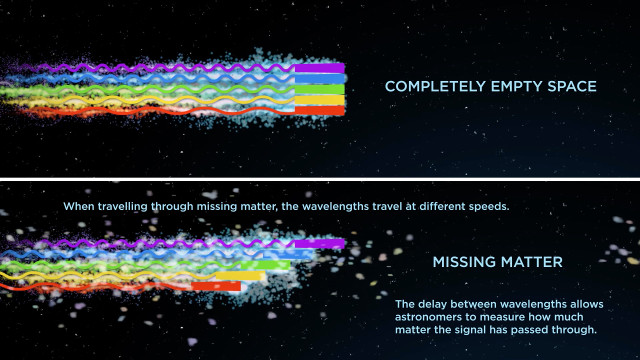
Professor Jean-Pierre Macquart stated that his team had also identified the relationship between the distance of a fast radio burst and how it expands as it travels the universe. It’s an equivalent of the Hubble-Lemaitre law, the one that states that the greater the distance from a galaxy the faster it moves away, only for fast radio bursts. The electromagnetic radiation of a burst is spread by the missing baryonic matter even if it’s extremely rarefied in the same way in which the colors of the sunlight are separated in a prism generating delays in the various wavelengths. All this information made it possible to measure the density of the universe. The bottom image (Courtesy ICRAR. All rights reserved) illustrates the effect of intergalactic gas on fast radio bursts’ radio waves.
The ASKAP radio telescope enabled a leap forward in the study of fast radio bursts, significantly increasing their detection. SKA could detect even more of them making this universe density measurement method relatively easy to implement with multiple measurements over time. This will allow for example to find intergalactic clouds undetectable by other methods.