May 2020

The HTV-9 cargo spacecraft captured by the Canadarm2 robotic arm (Image NASA TV)

A little while ago the HTV-9 “Kounotori” spacecraft was captured by the International Space Station’s Canadarm2 robotic arm, operated by Chris Cassidy with the assistance of Ivan Vagner. The Japanese space cargo ship, which blasted off last Wednesday, carries a huge amount of supplies and experiments. After its capture, they started the slow moving of HTV-9 to its berthing location on the Harmony module, where it will be safely installed.

Wolfe Disk seen by ALMA

An article published in the journal “Nature” reports a study on the galaxy nicknamed Wolfe Disk that shows that it formed very early, to the point that it already had the shape of a disk galaxy about 1.5 billion years after the Big Bang. A team of researchers used the ALMA radio telescope to study this galaxy and find evidence of its characteristics that make it the oldest with a rotating disk found so far. Its existence so early in the history of the universe poses a problem for the current galactic formation models.

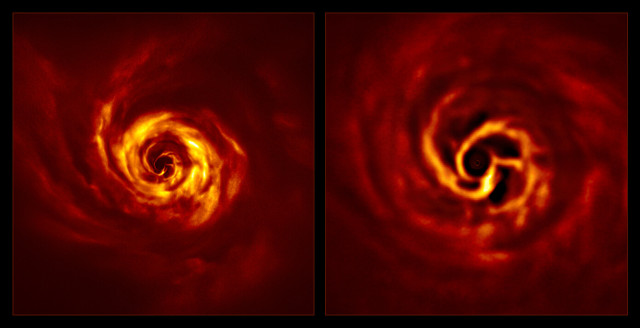
The AB Aurigae system seen by SPHERE

An article published in the journal “Astronomy & Astrophysics” reports evidence of the existence of a planet in formation in the protoplanetary disk surrounding the young star AB Aurigae. A team of researchers led by Anthony Boccaletti, of the Observatoire de Paris, PSL University, France, used the SPHERE instrument mounted on ESO’s VLT in Chile to find traces of what could be a planet. SPHERE takes real photos of the objects, so if the discovery was confirmed it would be the first direct evidence of a planet seen while it’s forming.

The HTV-9 spacecraft blasting off atop a H-IIB rocket (Image courtesy JAXA)

A little while ago the HTV-9 spacecraft blasted off atop a H-IIB rocket from the Tanegashima space center in Japan for a resupply mission to the International Space Station. About fifteen minutes after the launch, the cargo spacecraft separated regularly from the rocket’s last stage, entered its preliminary orbit and deployed its solar panels and navigation antennas.

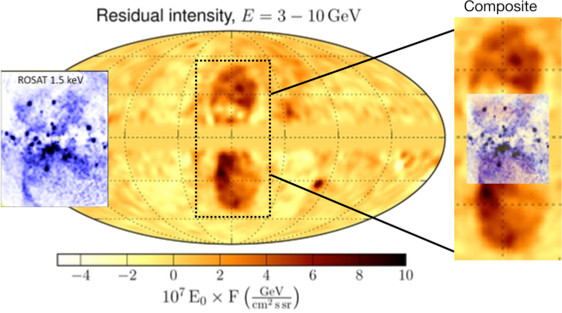
Gamma-ray and X-ray observations of the center of the Milky Way

An article published in “The Astrophysical Journal” offers an explanation of the origin of the so-called Fermi bubbles, the two gigantic gas bubbles existing above and below the center of the Milky Way. Guo Fulai and Zhang Ruiyu of the Shanghai Astronomical Observatory (SHAO) of the Chinese Academy of Sciences conducted a series of simulations that allowed to create a model that explains the origin of the Fermi bubbles and at the same time of the biconical X-ray structure at the center of the galaxy. According to the new model, the two phenomena are caused by shock waves generated by two jets from Sagittarius A*, or simply Sgr A*, the supermassive black hole at the center of the Milky Way, around 5 million years ago.