
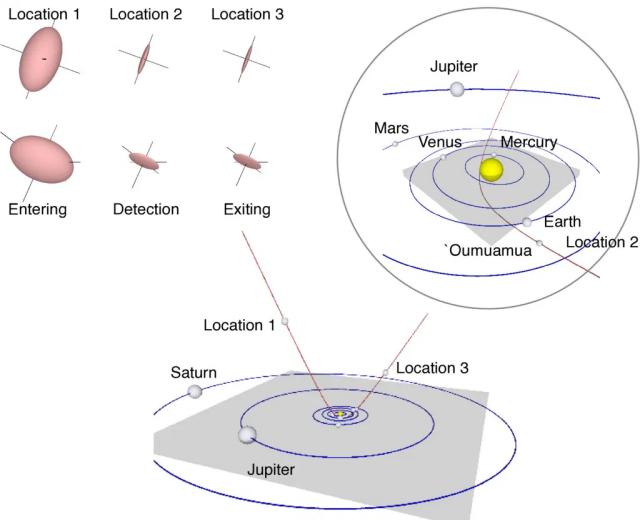
An article accepted for publication in the “Astrophysical Journal Letters” reports a study on the interstellar asteroid 1I/2017 U1 / ‘Oumuamua that offers an explanation for its strange properties. Professor Gregory Laughlin of the University of Yale and Dr. Darryl Seligman of the University of Chicago examined the data collected during the various observations of ‘Oumuamua concluding that it could contain a significant percentage of hydrogen ice and could have originated in the heart of a molecular cloud.
The discovery that happened in October 2017 of the asteroid later formally classified as 1I/2017 U1 and named ‘Oumuamua raised the interest of many astronomers after the orbital calculations indicated that it arrived from interstellar space.
The observations showed from the beginning a very elongated shape that is really out of the ordinary which immediately led to discussions. Various hypotheses were made on its origin, and the detection of an acceleration that can’t be explained by the attraction of planets or at least moons in its vicinity even led to speculate that it was an alien spaceship. This also makes sense because it was the subject of serious scientific verification that ruled out that it’s an artificial object, but questions about its strange characteristics remained. An answer was proposed that offers an explanation for those oddities.
Darryl Seligman earned a doctorate from Yale University, where he worked with Professor Gregory Laughlin. Together, the two researchers examined the data about ‘Oumuamua to try to understand its real nature. According to them, if an interstellar asteroid were a kind of iceberg composed mainly of hydrogen, it would have the observed characteristics. It would be a truly exotic object, different from the asteroids and comets we know.
An object composed mainly of hydrogen could have formed in the heart of a molecular cloud, where very cold gas can become a nursery for the birth of new stars. Within that type of cloud, temperatures can even be a few degrees above absolute zero, what’s needed for hydrogen to become solid. Hydrogen icebergs could be produced and subsequently pushed into interstellar space by the gravitational force of protostars.
If this theory is correct, once it entered the solar system, the interstellar asteroid ‘Oumuamua started feeling the influence of solar emissions, which resulted in the sublimation of the hydrogen on its surface. Professor Gregory Laughlin used the metaphor of the soap bar that is consumed in a way that gives it an elongated shape, just like that of ‘Oumuamua. The hydrogen emitted due to sublimation might have generated the abnormal acceleration, which had led many astronomers to wonder if it was actually a comet.
The image (Courtesy Gregory Laughlin and Darryl Seligman. All rights reserved) shows a diagram of the evolution of the interstellar asteroid ‘Oumuamua’s size and shape due to the sublimation of hydrogen and its trajectory through the solar system.
According to the two researchers, there could be an abundant population of objects such as ‘Oumuamua that can occasionally end up in some star system after forming in a molecular cloud. The Comet Interceptor mission proposed by ESA to send into space spacecraft ready to intercept passing comets could be useful for studying objects such as’ Oumuamua. The idea that hydrogen icebergs travel in space is interesting, and certainly other researchers will study it.

Permalink