
An article published in the journal “Physical Review Letters” reports a new estimate of the expansion of the universe based on the large cosmic structures formed by galaxies. A team of researchers led by Dr. Seshadri Nadathur of the British University of Portsmouth’s Institute of Cosmology and Gravitation (ICG) used data about over one million galaxies and quasars collected over a decade by the Sloan Digital Sky Survey to create an analysis that provided a measure of the effects of the mysterious dark energy that’s accelerating the expansion of the universe. Adding a new method of its calculation doesn’t necessarily lead to the right value, but can help understand why other methods provide incompatible results and where we might need to expand our knowledge of physics to obtain the right value.
By now the Hubble constant, as the velocity of the universe expansion is called, has been calculated in several different ways ranging from the use of cosmic background radiation to that of supernovae, quasars, cepheids, red giants and more. The results were often incompatible with each other, too different even taking into account their error margins, creating what was called a tension in the field of physics. This problem suggests that our knowledge of the laws of physics is still too limited to obtain precise results and analyzing the different methods used with the different values obtained might provide some suggestions on the possibilities to be explored.
Among the new ideas developed there’s the one of Dr. Seshadri Nadathur’s team, based on a combination of cosmic voids, vast expanding “bubbles” of space that contain very few galaxies, and the weak footprint of sound waves in the early universe, known as baryonic acoustic oscillations (BAO), which can be observed in the distribution of galaxies. This provides a precise ruler to measure the direct effects of dark energy that’s driving the acceleration in the expansion of the universe.
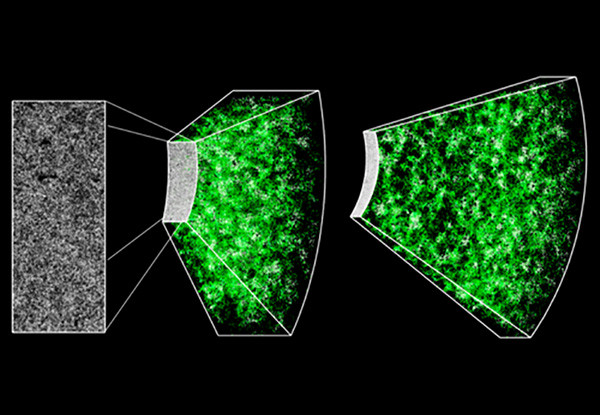
The image (Courtesy Jeremy Tinker and the SDSS-III collaboration. All rights reserved) shows a section of the three-dimensional map of the galaxies of the Sloan Digital Sky Survey used for this analysis. The rectangle on the left shows an area of sky that contains nearly 120,000 galaxies. The images in the center and on the right show the three-dimensional map created from those data: the brightest regions correspond to the regions of the universe with more galaxies while the darkest regions correspond to the voids.
Putting all the data together, the value obtained for the Hubble constant is 69.0 ± 1.2 kilometers per second per megaparsec. According to the researchers, this new method gives much more precise results than the technique based on the observation of the explosion of massive stars, the standard method to measure the direct effects of dark energy. Other methods have been used in recent years to try to obtain greater precision and understand the reasons for the incompatible results obtained with different methods.
This new result is closer to the one based on the final release of ESA’s Planck Surveyor space probe data with a value of 67.4 kilometers per second per megaparsec with a margin of uncertainty that’s less than 1%. It could be a step forward, but it remains to be seen if the analysis of the various results obtained will bring progress in our cosmological models. The goal is to understand if dark energy really exists, in a positive case what’s its nature and in any case what’s the cause of the acceleration of the expansion of the universe.
