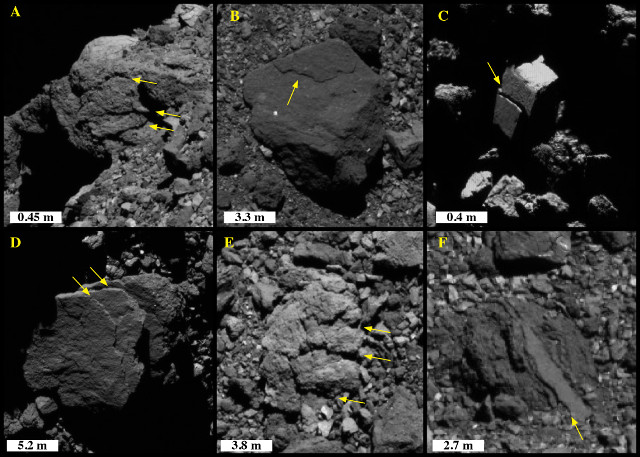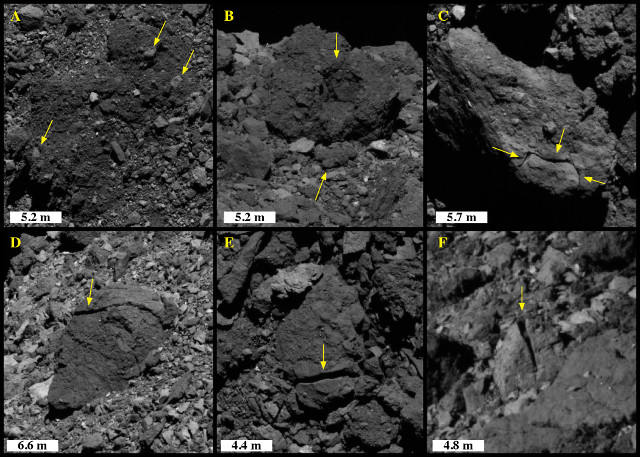
An article published in the journal “Nature Communications” reports the evidence of thermal fractures on asteroid Bennu caused by the temperature difference between day and night. A team of researchers led by Jamie Molaro of the Planetary Science Institute in Tucson, Arizona, examined images of Bennu’s surface captured by NASA’s OSIRIS-REx space probe, and found examples of this phenomenon. It’s the first detection of this phenomenon on an object without an atmosphere, and this offers new information to understand the evolution of Bennu and in general of asteroids over time. That includes the progressive disaggregation of rocks through the particular effect of thermal fracturing called exfoliation.
The OSIRIS-REx (Origins, Spectral Interpretation, Resource Identification, and Security-Regolith Explorer) space probe reached asteroid Bennu, formally 101955 Bennu, on December 2, 2018, and began to closely study what’s considered a primitive object similar to the ones that brought water and organic materials to Earth.
The temperature on the surface of asteroid Bennu can reach 125° Celsius during the day and plummet to -75° Celsius at night. Its rotation period is just over 4 hours, so the temperature difference between day and night and vice versa is really abrupt, generating considerable thermal stress. This phenomenon leads to the formation of cracks in Bennu’s surface, which expand over time in a process of weathering by thermal stress. One effect is exfoliation, which causes the most superficial layers of rocks to detach.
The top image (NASA/Goddard/University of Arizona) shows the disaggregation (top row) and linear fractures (bottom row) in rocks on asteroid Bennu. In the bottom row, the fracture orientation is from west-northwest to east-southeast (D) and from north to south (E, F). The bottom image (NASA/Goddard/University of Arizona) shows the exfoliation of a cliff face (A) and on rocks of various sizes and positions (B-F).
On Earth, rains and chemical activities can generate similar formations, but asteroid Bennu doesn’t have an atmosphere that can support these processes. Earth’s rocks can be crushed by a tectonic activity but Bennu is too small for that to happen on it. Meteoroid impacts can crack rocks, but wouldn’t generate the even erosion of layers such as that found on Bennu, and in any case there’s no trace of impact craters in the areas where exfoliation processes were detected.
The close study by the OSIRIS-REx space probe allowed to obtain high quality images of asteroid Bennu’s surface and to discover for the first time thermal fractures on an object without atmosphere. Now it will be possible to continue the research to compare these processes with other similar ones of weathering to better understand what happens on the surface of the asteroids, in particular on those relatively close to the Sun, where the temperature difference between day and night is very high. In the long run, these changes can even affect the orbit of an asteroid, and in the case of the ones that cross the Earth’s orbit it can change the odds of impact on Earth.